
The Ultimate Evacuation First Aid Kit Guide 2025
Published by Jax First Aid Supplies on 3rd Dec 2025
Evacuation First Aid Kit Guide 2025 – Evac Chairs, Mats & Essentials for UK Safety
If you manage a building, workplace, block of flats or any occupied premises in the UK, having a well stocked evacuation first aid kit, evacuation aids (such as an evacuation chair or evac mat), as well as a clear plan could make all the difference in an emergency. In 2025, with evolving regulatory expectations and a higher focus on accessibility, taking a proactive approach to first aid and evacuation planning is not just best practice, it is a highly important responsibility.
Emergencies can happen anywhere; workplaces, residential buildings, schools, community centres, or busy public venues. When they occur, people rely on two things more than anything else: a safe evacuation route and fast access to first aid supplies. That is where a well prepared evacuation first aid kit, in conjunction with equipment such as evac chairs and evac mats, becomes utterly essential.
In the UK, evacuation planning isn’t just common sense, but is shaped by legal responsibilities and national safety standards. With updated fire safety expectations, and evolving workplace demands, 2025 is the best year to review your evacuation setup and upgrade your supplies and tools made to protect lives.
The Rising Importance of Evacuation First Aid in 2025
Why must UK workplaces take evacuation readiness seriously?
The last few years in the UK have brought about a renewed focus on building safety, with updates to the fire safety legislation and a greater scrutiny on evacuation procedures. When people need to leave a building fast, whether due to fire, structural danger, medical emergencies, or security threats, they tend to be stressed, disoriented and vulnerable to injury.
During evacuations, the most common injuries could include:
- Cuts from broken glass or fixtures;
- Sprains or fractures from rushing or slipping;
- Burns from fire or contact with hot surfaces;
- Shock or hypothermia once outdoors;
- Breathing difficulties from smoke exposure.
In these critical moments, having fast access to bandages, dressings, foil blankets, and a fully stocked first aid kit can help to prevent minor injuries from becoming major injuries.
How does fire safety and first aid law influence evacuation planning?
UK law does not list every specific item you must have in an emergency as a business owner, however, it does require the responsible individual to make sure there is “adequate and appropriate” first aid supplies, and safe evacuation planning, based on a risk assessment for that specific workplace/building.
This includes:
- Providing sufficient first aid kits;
- Making sure escape routes are safe;
- Planning for people with minimised mobility;
- Training staff or residents;
- Conducting regular risk assessments.
The phrase “adequate and appropriate” is deliberate, as a first aid kit for a tiny one floor retail shop is completely different from what is needed in a multi-storey office or block of flats.
This is why evacuation first aid planning must be tailored to the building itself.
Understanding UK Legal Duties Around Evacuation and First Aid
What are the health and safety (first aid) regulations 1981?
These regulations place a duty on employers to provide:
- A suitable first aid kit;
- Trained first aiders, where needed;
- Information for employees;
- Fast access to visible equipment.
The legislation does not give a fixed list of contents, but instead, it requires a first aid needs assessment to determine what is needed based on:
- The building size;
- The number of people;
- The type of work;
- The level of risk;
- The distance from emergency medical services.
This means your evacuation first aid kit should match your specific environment, rather than a one-size-fits-all first aid template.
What are the fire safety laws & evacuation duties under the fire safety order?
The Regulatory Reform (Fire Safety) Order 2005, along with improvements introduced by the Fire Safety (England) Regulations 2022, puts responsibility on the Responsible Person, typically the employer, building owner, landlord or managing agent.
They must:
- Carry out fire risk assessments;
- Make sure people can evacuate safely;
- Plan for disabled occupants;
- Store appropriate evacuation equipment.
That last point is where tools like an evac chair, evac mat or even a stretcher become important in multi-storey buildings.
Where does evacuation first aid fit into your risk assessment?
A full UK-compliant risk assessment looks at:
- Who may need help;
- What injuries might occur during evacuation;
- Whether first aid kits are positioned correctly and visibly;
- Whether evac chairs are needed;
- Whether evac mats are required for non-ambulant people;
- Whether staff or residents understand how to evacuate safely.
Once these factors have been considered, you should have a clear idea of what your evacuation first aid kit should include.
What Makes a High Quality Evacuation First Aid Kit?
Bandages, dressings, wipes & foil blankets:
Every evacuation first aid kit should contain a set of well organised, sterile first aid supplies made to treat injuries common during evacuations.
These could include:
- Sterile bandages and dressings
- Large wound pads
- Conforming bandages for sprains
- Eye pad dressings
- Triangular bandages
- Sterile wipes
- Nitrile gloves
- Microporous tape
- Scissors
- A foil blanket to treat shock or cold exposure
Foil blankets play a more important role than most people may realise. Once people escape outdoors, especially in cold weather, shock and temperature drops can set in fast.
Why is BS 8599-1:2019 the gold standard?
Although not mandatory by law, the BS 8599-1 standard is widely seen as the UK’s most reliable first aid benchmark. It outlines:
- The ideal contents to supply;
- What each item is used for;
- How many of each item a workplace should hold based on size.
What are the items often forgotten but vital in an evacuation?
Many people overlook key items that can make evacuations safer, such as:
- Burn dressings;
- CPR face shields;
- Extra gloves;
- Heavy duty shears for clothing;
- Multiple foil blankets;
- A grab bag style carry case for mobility.
Evacuation Equipment: Evac Chairs, Evac Mats & How They Save Lives
What does an evac chair do, and when should UK buildings have one?
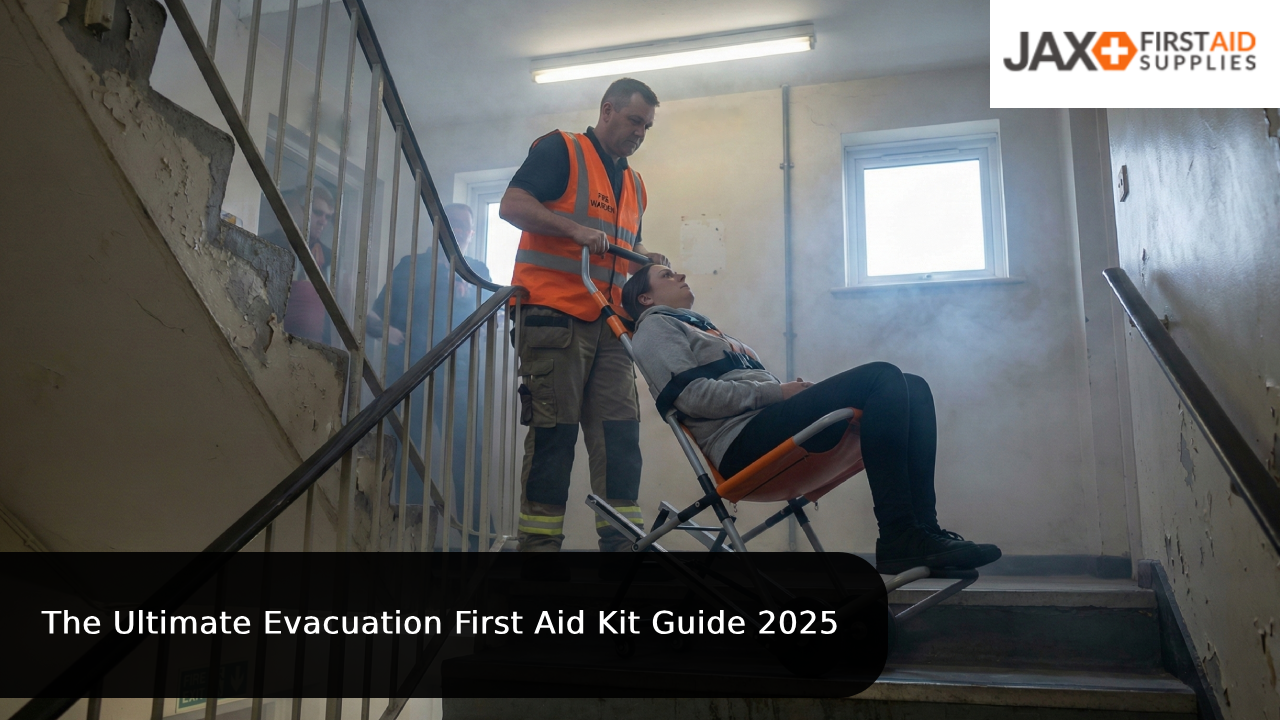
An evac chair is a specially made chair that allows trained staff to safely transport a person with limited mobility, whether due to disability or injury, down staircases during an evacuation.
They are essential in:
- Multi-storey offices;
- Shared residential buildings;
- Schools and colleges;
- Hospitals and clinics;
- Public venues;
- Any building with stairs where lifts cannot be used in a fire.
Fire safety law expects buildings to plan for people who cannot evacuate without assistance, which means relying on evac chairs is not optional in some cases.
Evacuation Mats: Why Every Multi-Storey Building Should Consider One
An evac mat is a low friction rescue device allowing staff to slide a person along the floor or down stairs when an evac chair is not available or suitable.
They are perfect for:
- People who cannot sit upright
- Medical emergencies
- Narrow stairways
- Large buildings requiring fast movement
Evac mats are inexpensive, durable and incredibly effective for emergency evacuation.
Where to Position First Aid Kits, Chairs & Mats
A good rule is:
- At least one first aid kit per floor;
- At least one evac chair near each protected stairwell;
- Evac mats in strategic points near escape routes;
- Signage that is highly visible even during power failure;
- Kits placed no more than 60 seconds away from major work areas.
If someone collapses or suffers an injury, fast access to first aid supplies is crucial.
Training Staff & Residents: The Secret to a Safe Evacuation
Even the best equipment fails if people do not know how to use it correctly.
Training should include:
- How to locate kits and evac chairs
- How to treat bleeding
- How to use an evac chair safely
- How to treat someone in shock
- How to call emergency services quickly
Common Mistakes That Put People at Risk (and How to Avoid Them)
Even well intentioned organisations can make easily avoidable mistakes, such as:
- Keeping out-of-date first aid kits;
- Forgetting foil blankets;
- Storing first aid kits where staff can’t reach them fast;
- Buying cheap, non-compliant kits;
- Not having evac chairs for multi-storey buildings;
- Not training anyone to use an evac mat;
- Assuming mobile phone torches are enough in the dark;
- Failing to replace used, or expired, first aid supplies.
Fixing these issues is typically inexpensive, and significantly improves safety.
Why 2025 Is the Year to Upgrade Your Evacuation First Aid Kit
A building that is fully prepared for evacuation is a building that protects its occupants. With UK safety standards evolving, now is the time to strengthen your evacuation approach, by investing in high quality first aid kits, adding foil blankets, bandages and burn dressings, incorporating evac chairs or mats, and make sure your staff or residents know exactly what to do and where to go when an alarm sounds or emergency occurs.
An evacuation first aid kit is not just a box of supplies; it is peace of mind, legal compliance, and possibly the difference between life and death in an emergency.