
Bleed Control Kits vs Standard First Aid Kits: 9 Critical Differences Every UK Workplace Should Know
Published by Jax First Aid Supplies on 18th Feb 2026
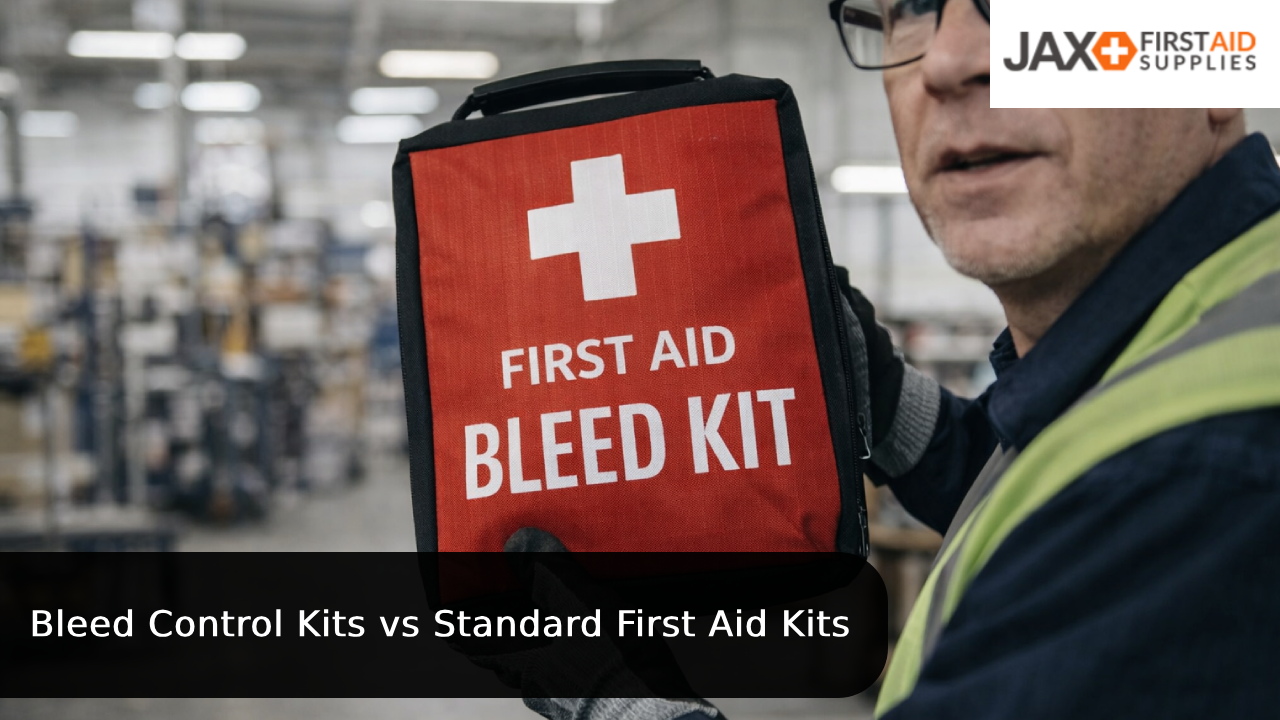
When it comes to workplace safety, understanding the difference between a Bleed Control First Aid Kit and a Standard First Aid Kit is no longer optional, but essential.
Across the UK, employers are reassessing their emergency preparedness in response to increased awareness of traumatic injuries, public safety incidents, and updated best practice guidance. While standard first aid kits are still mandatory in most workplaces, bleed control kits are becoming an increasingly important addition.
Why Understanding Bleed Control Kits vs Standard First Aid Kits Matters
Rising Awareness of Trauma Response in the UK
In recent years, emergency response standards have greatly evolved. Public access trauma kits are now much more common in shopping centres, schools, transport hubs, and large venues.
Severe bleeding, also known as catastrophic haemorrhage, can be fatal within minutes. Ambulance response times, while steadily improving, cannot always guarantee immediate intervention. This has driven greater awareness of specialist bleed control equipment.
Employer Duty of Care and Legal Responsibilities
Under UK law, employers have a clear duty of care to protect their employees and visitors. The Health and Safety at Work etc. Act 1974 requires employers to make sure, as far as reasonably practicable, the health and safety of employees and others.
Additionally, the Health and Safety (First Aid) Regulations 1981 requires employers to stock adequate and appropriate equipment, facilities, and personnel based on workplace risk assessments. Therefore, for higher risk environments, a standard first aid kit may not be sufficient.
What Is a Standard First Aid Kit?
A standard first aid kit is typically used to treat minor injuries and stabilise common workplace injuries.
Typical Contents Under UK Guidance
While there is no legally fixed list, HSE guidance commonly recommends:
- Sterile adhesive dressings
- Plasters
- Sterile eye pads
- Triangular bandages
- Safety pins
- Medium and large sterile dressings
- Disposable gloves
These kits are commonly suitable for:
- Minor cuts
- Small wounds
- Burns
- Sprains
- Eye irritation
They are required in almost all UK workplaces.
Where Are Standard First Aid Kits Made To Be Used?
Standard first aid kits are primarily made for:
- Low-risk office environments
- Retail settings
- Small workplaces
- Minor injuries requiring basic wound care
They are not made to manage catastrophic bleeding or traumatic limb injuries. That is where bleed control kits differ significantly.
What Is a Bleed Control Kit?
A bleed kit, sometimes called a trauma kit, PaCT kit or catastrophic bleed kit, is specifically made to manage severe, life threatening bleeding.
What is the purpose of a Bleed Kit?
The primary aim is simple:
To stop massive blood loss fast, until emergency services arrive.
Severe bleeding can cause unconsciousness within minutes. Immediate intervention can mean the difference between life and death.
Core Components of a Bleed Control Kit
A professional bleed control kit typically includes:
- Combat Application Tourniquet (CAT-style)
- Trauma dressing
- Haemostatic gauze
- Emergency shears
- Gloves
- Clear instructions
For example, the bleed control first aid kit we sell is specifically made to support effective catastrophic bleed response in line with UK best practice. These components go far beyond the capability of standard first aid kits.
Bleed Control Kits vs Standard First Aid Kits: Key Differences Explained
Let’s clearly compare.
1. Type of Injuries Treated
|
Standard First Aid Kit |
Bleed Control Kit |
|
Minor cuts |
Severe arterial bleeding |
|
Sprains |
Traumatic limb injury |
|
Small burns |
Penetrating trauma |
|
Eye irritation |
Catastrophic haemorrhage |
Standard first aid kits stabilise. Bleed control kits save lives during trauma.
2. Equipment and Medical Capability
Standard kits:
- Basic wound dressings;
- No tourniquet;
- No haemostatic agents.
Bleed control kits:
- Tourniquets made to occlude blood flow;
- Haemostatic gauze to promote clotting;
- Pressure trauma dressings.
The capability difference is significant.
3. Training Requirements
Basic first aid training covers wound dressing and bandaging.
However, bleed control equipment such as tourniquets requires specific training. Many UK training providers now include catastrophic bleed modules in First Aid at Work courses.
Proper training allows for safe and effective use.
4. Placement and Accessibility
Standard kits:
- Located in offices;
- Stored in cupboards, first aid cabinets or mounted cases.
Bleed control kits:
- Installed in high risk areas;
- Often wall mounted and clearly marked;
- Positioned for fast access.
In public venues, they may be placed alongside AED cabinets.
UK Law and Regulations on First Aid Provision
Health and Safety (First Aid) Regulations 1981
These regulations require employers to assess:
- Workplace hazards;
- Number of employees;
- Type of work conducted;
- Accident history.
There is no explicit legal requirement stating “you must have a bleed control kit.” However, if your risk assessment identifies a risk of severe bleeding, such as farming, industrial or construction work, you must provide appropriate equipment.
HSE Risk Assessment Requirements
The HSE makes clear that first aid provision must match the level of risk.
High risk environments could include:
- Construction sites
- Manufacturing plants
- Warehouses
- Security operations
- Event venues
- Schools with larger campuses
In these workplaces, relying solely on standard first aid kits may be considered inadequate.
When Should a Workplace Add a Bleed Control Kit?
Higher Risk Industries
You should strongly consider a bleed control kit if your workplace involves:
- Sharp tools
- Machinery
- Power tools
- Public access
- Large crowds
Severe bleeding risks greatly increase in these environments.
Public Facing Venues and Schools
Many schools, shopping centres, and sports facilities now install bleed control kits as part of broader safeguarding initiatives.
This proactive approach demonstrates a strong duty of care.
Recommended Placement of Bleed Control Kits
For maximum effectiveness it is recommended to:
- Install near high risk work areas;
- Mount clearly on walls
- Place near AED units;
- Ensure staff know the location;
- Include signage.
Frequently Asked Questions
Are bleed control kits mandatory UK? ▼
Can standard first aid kits stop bleeding? ▼
What items are in bleed kits? ▼
Is staff training required? ▼
Should schools install bleed kits? ▼
How often should I inspect my bleed kits? ▼
Do bleed kits replace first aid? ▼
Where should bleed kits be located? ▼
Are bleed kits single use? ▼
Which workplaces benefit most from bleed kits? ▼
What kit size should I choose? ▼
If you have any further questions about this product feel free to ask a question in our customer question box below, or contact our sales team.