
Bleed Control Kits for Schools and Universities
Published by Jax First Aid Supplies on 20th May 2026
A School and University Trauma/Bleed Kit Guide
A bleed control kit is designed to support a fast response when someone suffers severe bleeding, a catastrophic bleed, a major bleed or another life-threatening injury. For schools, colleges and universities, the right bleeding control equipment can help a responder take immediate action while professional medical help is on the way.
A standard first aid kit is still important for everyday injuries, but it may not contain the specialist medical supplies needed to help control life-threatening bleeding. That is why many education sites are reviewing whether they should add a bleed control kit, bleed kit, trauma kit, Public Access Trauma PAcT First Aid Kit or publicly accessible emergency bleed control point to their wider first aid provision.
This guide explains what a bleed control kit is, why schools and universities may choose to stock one, where to store a kit, and what bleeding control products to consider for education settings.
Quick Answer: Do Schools and Universities Need a Bleed Control Kit?
Not every school, college or university is automatically required to have a bleed control kit. First aid and bleeding control equipment should be chosen using a first aid needs assessment, site risk assessment, the number of pupils, students, staff and visitors, the activities taking place, public access, site layout and likely emergency response times.
A bleed control kit may be worth considering for education sites with sports facilities, science labs, food technology rooms, design and technology workshops, engineering areas, construction training spaces, large public events, open campuses, outdoor activity areas or higher footfall.
Shop relevant supplies: Bleed Control First Aid Kit, Build Your Own Bleed Control First Aid Kit, TraumaFix Bleed Control Kit Pro, Public Access Trauma PAcT First Aid Kit and BS8599-1:2019 Critical Injury First Aid Pack.
What Is a Bleed Control Kit?
A bleed control kit is a specialist first aid kit designed to help control severe bleeding quickly. The aim is to give a trained first aider, school responder, university security team, member of staff, bystander or member of the public access to essential bleeding control supplies during the first few minutes of an emergency.
Severe bleeding can become life-threatening very quickly. In a catastrophic bleed or critical bleed, every second counts. A suitable bleed control kit can help a responder apply pressure, use a trauma dressing, pack a wound with gauze, use haemostatic gauze where appropriate, apply a tourniquet where suitable, and support the casualty until an ambulance, paramedic or other professional medical help arrives.
A bleed kit does not replace emergency services, first aid training or a school first aid needs assessment. It is emergency equipment designed to support immediate action when someone needs help to stop bleeding, control bleeding and reduce blood loss before help arrives.
Why Are Schools and Universities Reviewing Bleed Kits?
More education sites are reviewing bleed and trauma supplies because emergency preparedness is becoming a bigger part of site safety planning. This does not mean every organisation has the same risk, but it does mean many schools, colleges and universities are asking whether they are prepared to respond to severe bleeding, a critical bleed or a life-threatening incident.
Schools may review bleeding control equipment because of sports fields, playgrounds, design and technology rooms, science labs, food technology areas, site maintenance teams, school trips and public events. Universities may review bleed supplies because of open campuses, student accommodation, laboratories, engineering departments, sports facilities, workshops, public venues, unions and large events.
Some education buyers are also influenced by wider public safety discussions, security planning, ambulance response times, risk assessments and the conversation around Martyn’s Law, often searched as ‘martyn’s law’. That law relates to the protection of premises and preparedness for qualifying premises and events, but it should not be treated as a blanket requirement to buy a bleed control kit for every school or university.
Bleed Control Kit, Trauma Kit and Standard First Aid Kit: What’s the Difference?
The terms bleed control kit, trauma kit and first aid kit are sometimes used together, but they are not always the same thing.
Standard First Aid Kit
Best for everyday first aid such as small cuts, plasters, bandages, dressings, gloves and basic first aid items.
Bleed Control Kit
Best for emergency bleed control, severe bleeding, catastrophic bleeding, traumatic wounds and fast bleeding control response.
Trauma Kit
Often broader than a bleed kit and may include trauma dressings, haemostatic products, tourniquet, shears, gloves, foil blanket and other emergency supplies.
A standard first aid kit remains essential for education first aid. However, where severe bleeding or critical injury is a foreseeable risk, an organisation may decide that a dedicated bleed control kit, Personal Trauma Kit, Emergency Trauma Kit in Red Emergency Bag or Major Incident Kit is a sensible addition.
Where Might Schools Need Bleeding Control Supplies?
Schools may want to review bleeding control supplies in areas where serious injury is more likely, or where a responder may need fast access to a kit.
Common school locations include:
- Main reception or school office
- First aid room or medical room
- Sports hall, gym or changing room area
- Outdoor sports pitches and playgrounds
- Design and technology workshops
- Science labs and prep rooms
- Food technology rooms
- Site manager or caretaker areas
- Minibus, trip or outdoor learning points
- Large assembly halls or event spaces
A school bleed control kit should be clearly marked, easy to access and included in first aid planning. The kit should not be hidden in a cupboard that staff cannot access quickly during emergency situations.
Where Might Universities and Colleges Need Bleed Kits?
Universities and colleges often have larger, more varied sites than schools. A university may have laboratories, workshops, sports centres, student accommodation, public venues, open campuses, engineering areas and large events. This means one bleed control kit at reception may not be enough for every location.
Useful locations for university and college bleed supplies may include:
- Campus security office
- Reception and student services
- Sports centre, pitches and gym facilities
- Engineering, construction or trade training departments
- Science laboratories and technical workshops
- Student union and event venues
- Accommodation blocks
- Facilities and estates departments
- Open public areas or high-footfall entrances
- First aid rooms and AED points
For larger campuses, a mix of fixed and portable bleeding control options may be more practical than one central kit. A Bleed Control Cabinet can help make a fixed emergency point visible, while a Trauma Bag or Personal Trauma Kit may be useful for mobile response teams.
What Should a School or University Bleed Control Kit Include?
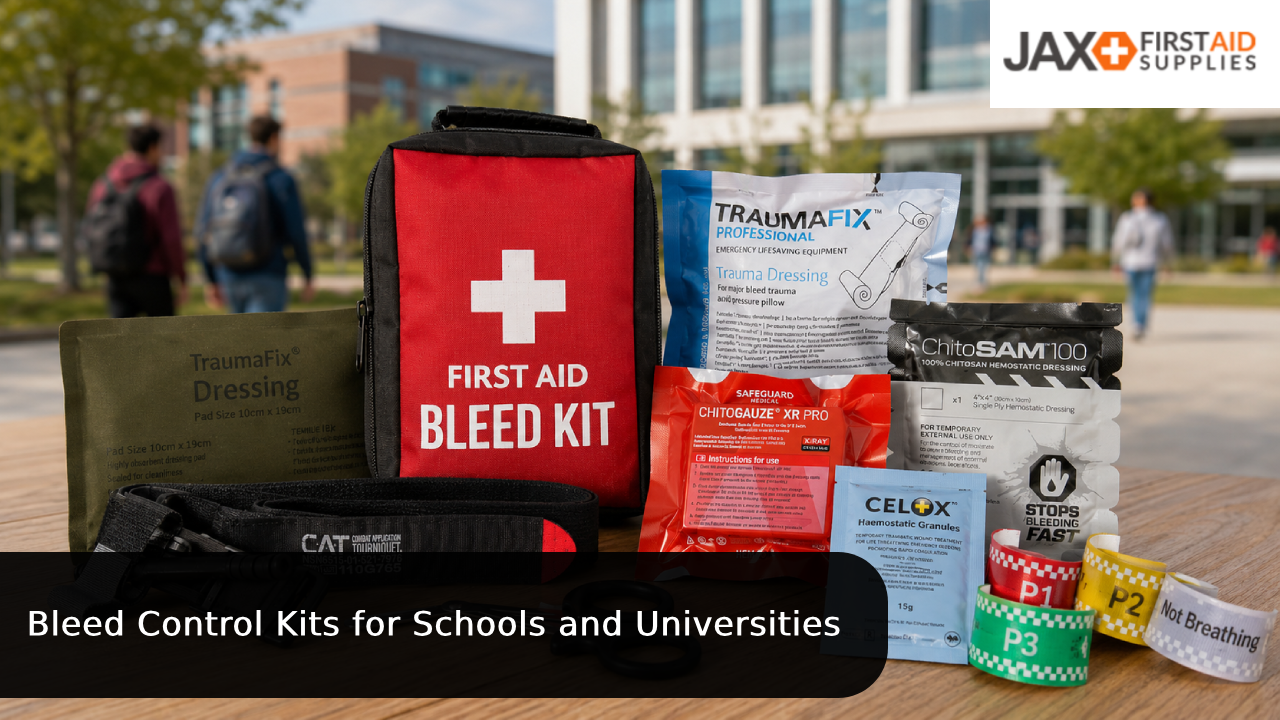
The exact contents depend on the kit type, product specification and risk assessment. A typical bleed control kit may include:
- TraumaFix Dressing or another emergency trauma dressing
- Trauma Dressing 15cm x 18cm or Trauma Dressing 10cm x 18cm
- ChitoGauze XR Pro, Celox Rapid Haemostatic Gauze or another haemostatic gauze
- Combat Application Tourniquet CAT or SOFTT Special Operations Forces Tactical Tourniquet
- Disposable gloves for responder protection
- Tuff cut shears or clothing scissors
- Foil blanket
- Clear bleeding control guidance leaflet
- Permanent marker for recording tourniquet application time where required
The kit includes items intended to support bleeding control and emergency response. The kit should be stored where a responder can access it quickly, and staff should understand the location, purpose and limitations of the equipment.
Important Safety Note
A tourniquet, haemostatic dressing, haemostatic gauze and trauma dressings can be life-saving in the right situation, but they should be used according to training, product instructions and emergency guidance. A bleed control kit supports first aid response; it does not replace professional medical help.
Product Pick: Bleed Control First Aid Kit
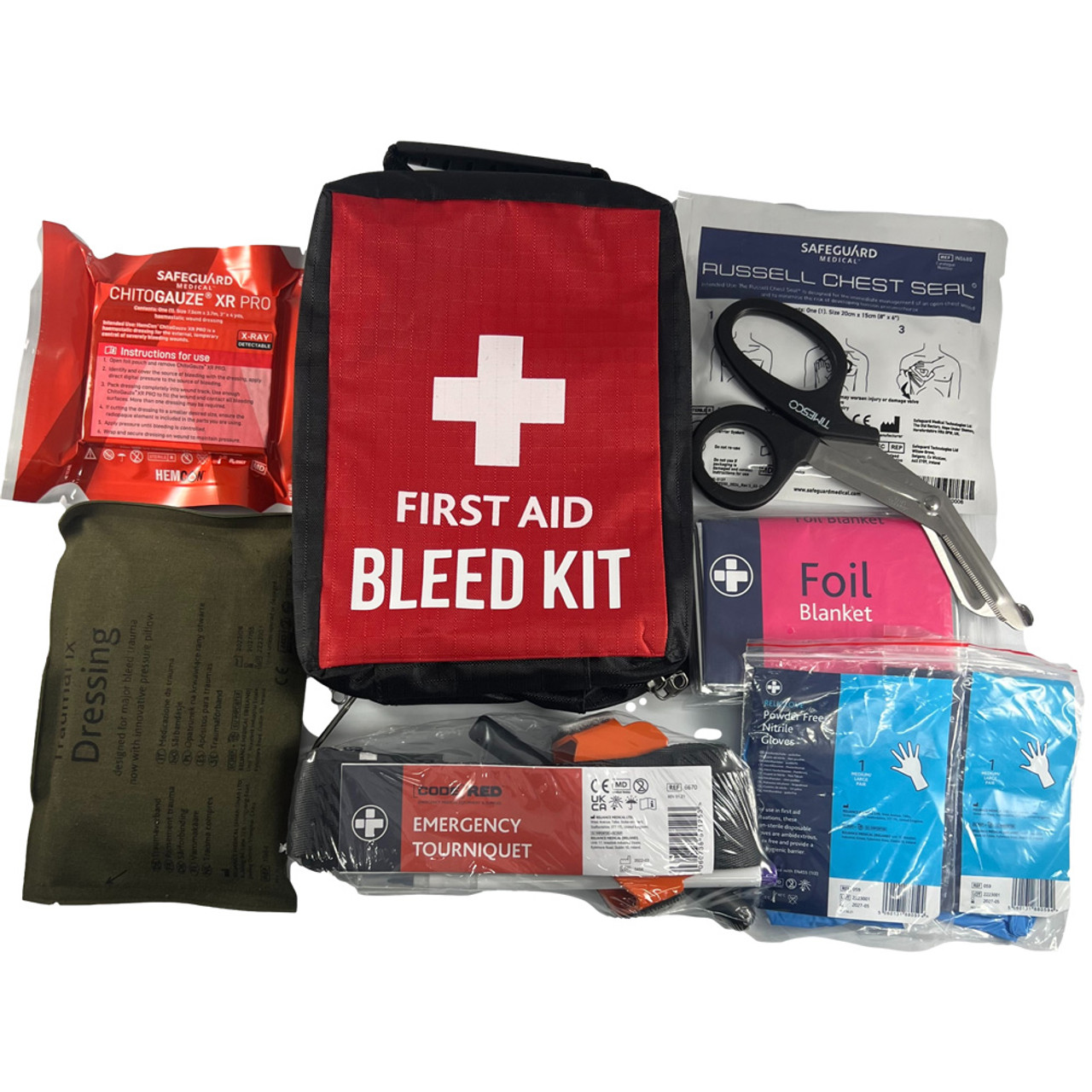
Bleed Control First Aid Kit
A compact bleed control kit designed for severe bleeding response, with key trauma and bleeding control supplies in one identifiable kit.
Best use cases: school first aid rooms, sports halls, university departments, student venues, workshops, labs and campus security points.
Public Access Trauma Kits for Education Sites
Some education sites may want a bleed control kit that is more visible and accessible, especially where there are large numbers of pupils, students, visitors or members of the public. A publicly accessible kit can support a bystander, first aider or responder while emergency services are contacted.
This can be especially relevant for universities, colleges, sports centres, public-facing school sites, event venues and education campuses that host community activity. A Public Access Trauma PAcT First Aid Kit may be suitable where an organisation wants accessible trauma supplies for life-threatening injuries and severe bleeding.
Product Pick: Public Access Trauma PAcT First Aid Kit
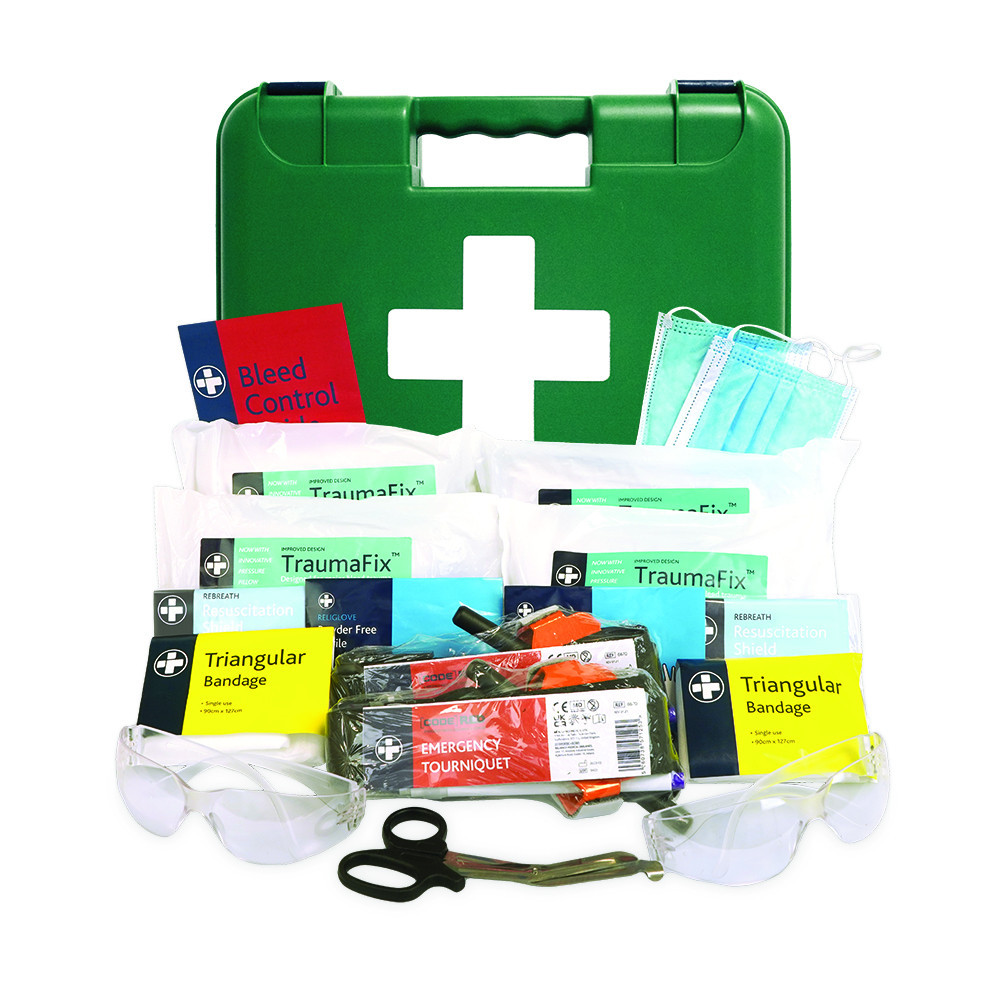
Public Access Trauma PAcT First Aid Kit
A public-access trauma kit designed for organisations that want accessible equipment for life-threatening injuries and major bleeding.
Best use cases: universities, colleges, sports centres, student unions, public event areas, large school sites and education venues with public access.
Should Schools and Universities Choose a Ready-Made Kit or Build Their Own?
A ready-made bleed control kit is often the simplest option because the key items are supplied together. This is useful for schools and universities that want a straightforward kit for first aid rooms, sports areas, workshops or reception points.
A custom kit may be better where the education site has specific risks, existing supplies or several locations to equip. For example, a university may want one setup for laboratories, another for sports facilities, and another for campus security.
Product Pick: Build Your Own Bleed Control First Aid Kit

Build Your Own Bleed Control First Aid Kit
A flexible bleed control kit option for education sites that want to choose their own contents, including trauma dressing options, haemostatic products, tourniquet options, gloves, shears and foil blanket.
Best use cases: schools, colleges, universities, estates teams, sports departments and first aid coordinators wanting a kit tailored to their site risks.
Where Should a Bleed Control Kit Be Stored?
A bleed control kit should be easy to find, clearly marked and close to the areas where severe bleeding is most likely to occur. The best location depends on your site layout, number of people, visitor access and risk profile.
Good locations may include:
- Main reception or security desk
- First aid room or medical room
- Sports hall, gym or outdoor pitch access point
- Design and technology workshop
- Science lab prep area
- Food technology department
- University laboratory or engineering building
- Student union or public venue
- Campus security office
- Public access defibrillator or emergency point
Do not hide the kit in a locked cupboard if it may be needed quickly. If the kit is for public access, use clear signs and consider whether staff, first responders or a member of the public could locate it during the first few minutes of an incident.
Should a Bleed Control Kit Be Wall-Mounted, Portable or Kept in a Bag?
The right storage method depends on the education site. A wall-mounted bleed control kit or cabinet can make emergency equipment visible. A portable trauma bag can be useful for sports fields, site teams, outdoor learning, campus security and responders who need to carry the kit to the casualty.
Portable Bleed Kit
Best for sports fields, outdoor learning, campus security, trips and situations where the kit needs to travel to the casualty. Consider a Personal Trauma Kit or empty trauma bag.
Wall-Mounted Kit
Best for first aid rooms, reception areas, workshops, sports halls and departments where a fixed first aid point is useful. Consider a Bleed Control Cabinet.
Public Access Kit
Best for universities, colleges, public venues, large campuses and locations where visibility, security and fast access matter.
Bleeding Control Dressings, Gauze and Tourniquets
The right bleeding control products depend on the kit, the level of risk and the intended responder. Some education sites choose a ready-made bleed control kit; others restock individual components.
Useful replacement or build-your-own products include:
- Israeli Civilian Bandage 4"/6"
- Blast Bandage
- TraumaFix Military Field Dressing
- Prometheus Trauma Dressing PTD
- ChitoGauze XR Pro
- Celox Rapid Haemostatic Gauze 5ft Z-Fold
- Axiostat Military 300cm Z-Fold Haemostatic Gauze
- Axiostat Military 150cm Z-Fold Haemostatic Gauze
- Celox Prefilled Applicator
- Genuine Combat Application Tourniquet CAT
- SOFTT Special Operations Forces Tactical Tourniquet
These products can help equip a responder to manage life-threatening bleeding, stop blood loss and support emergency response until help arrives. Product selection should be based on risk, training, site procedures and the level of first aid response expected.
Product Pick: TraumaFix Bleed Control Kit Pro

TraumaFix Bleed Control Kit Pro
An advanced bleed control kit for serious emergency preparedness, designed to support response to severe bleeding and traumatic injury incidents.
Best use cases: universities, colleges, sports facilities, public events, large campuses, engineering departments, security teams and higher-risk education sites.
Best Bleed Control Kit Options From Jax First Aid
Jax First Aid supplies a range of bleed, trauma and bleeding control products for schools, colleges, universities and education organisations across the UK.
Bleed Control First Aid Kit
A compact bleed control kit for schools, colleges, sports halls, workshops and education first aid points.
Build Your Own Bleed Control Kit
A customisable kit for education sites that want to choose trauma dressings, haemostatic products, tourniquet options and supplies.
Public Access Trauma PAcT Kit
A public-access trauma kit for universities, colleges, event spaces, sports facilities and busy education sites.
TraumaFix Bleed Control Kit Pro
An advanced trauma and bleed kit option for higher-risk education environments and public safety planning.
Bleed Control Cabinet
A visible storage option for sites that want bleed control equipment easy to locate and protect.
Critical Injury First Aid Pack
A BS8599-1:2019 critical injury first aid pack for education sites reviewing serious injury preparedness.
Major Incident and Multi-Casualty Preparedness for Education Sites
Some schools, colleges and universities may need more than one bleed control kit, especially if they are responsible for a large site, a public event space, student accommodation, sports facilities or multiple higher-risk departments.
In these cases, wider emergency preparedness may include a Major Incident Kit, NHS Ten Second Triage Slap Bands, Bleed Control Kit Titan Box Empty Small or additional trauma supplies stored across the site.
This may be relevant where an organisation is prepared to respond to a mass casualty event, critical injury, multiple casualties or incidents across a large site. The goal is to make the right kit available quickly, not to create a complicated system that staff cannot use under pressure.
What Training Should Staff Have?
A bleed control kit should be backed up by staff awareness and suitable first aid training. People should know where the kit is, what it is for, who is likely to use it, and when to call 999.
Training can help staff understand how to recognise severe bleeding, apply direct pressure, use trauma dressings, use a tourniquet where appropriate, support the casualty and communicate clearly with ambulance control. The goal is not to turn every person into a paramedic, but to help staff feel prepared to respond during emergency situations.
For public access locations, simple signage and clear instructions can also help a bystander or member of the public take immediate action until trained help arrives.
How Often Should Bleed Kits Be Checked?
A bleed control kit should be checked regularly, just like other first aid equipment. Items may have expiry dates, packaging can be damaged, and used products need to be replaced quickly.
Routine checks should include:
- Is the kit sealed and complete?
- Are sterile items in date?
- Is the tourniquet present and undamaged?
- Are trauma dressings, gauze and haemostatic gauze sealed?
- Are gloves, shears and instructions present?
- Is the kit easy to see and access?
- Does the location still match the site risk?
- Has the kit been restocked after use?
Common Bleeding Control Buying Mistakes
The biggest mistake is buying a bleed control kit without thinking about access, training and restocking. A kit locked away or hidden from responders is far less useful than one that is visible, signed and included in emergency response planning.
Common mistakes include:
- Only buying one kit for a large school, college or university campus
- Storing the kit too far from sports, workshop or laboratory areas
- Not telling staff where the kit is kept
- Not checking expiry dates on dressings and haemostatic products
- Buying a kit but not arranging awareness or first aid training
- Assuming a standard first aid kit can always stop severe bleeding
- Not adding signage for publicly accessible kits
- Failing to restock after use
Bleed Control Kit Buying Checklist for Schools and Universities
Before You Buy, Check:
- Could anyone on site suffer severe bleeding or a catastrophic injury?
- Which areas create the highest risk: sports, workshops, labs, kitchens, events or public access?
- Where would a responder need the kit fastest?
- Is one bleed kit enough, or does the site need several points?
- Should the kit be portable, wall-mounted or publicly accessible?
- Does the kit include a dressing, gauze, gloves, shears and tourniquet where appropriate?
- Do you need haemostatic dressing or haemostatic gauze for higher-risk scenarios?
- Is signage needed so people can find the kit quickly?
- Who checks and restocks the kit?
- Should the kit sit beside an AED, first aid point, reception desk or campus security point?
Final Thoughts: Choose Bleed Control Equipment Based on Education Site Risk
A bleed control kit is not about creating fear. It is about practical preparedness. When severe bleeding happens, the first few minutes matter. The right kit, in the right location, with clear awareness, can support a faster response while emergency services are on the way.
For schools, colleges, universities, sports facilities, public education venues and higher-risk departments, a bleeding control review can help decide whether a standard first aid kit is enough, or whether additional bleed, trauma and emergency response equipment should be added.
Jax First Aid supplies bleed control first aid kits, custom bleed kits, PAcT kits, TraumaFix bleed control kits, bleed control cabinets, trauma dressings, tourniquets and haemostatic gauze for education organisations across the UK.
Need Bleed Control Kits for a School or University?
Shop bleed control kits, trauma kits, PAcT kits, tourniquets, trauma dressings, haemostatic gauze and emergency response supplies from Jax First Aid.
View Bleed Control Kit View PAcT Kit Build Your Own Kit Ask About Bulk Orders
Frequently Asked Questions
What is a bleed control kit?
A bleed control kit is a first aid kit designed to help control severe bleeding and life-threatening bleeding. It may include trauma dressings, haemostatic gauze, a tourniquet, gloves, shears and clear bleeding control guidance.
Do schools need bleed kits?
There is not one universal rule that every school must have a bleed kit. Schools should use a first aid needs assessment and site risk assessment to decide whether a bleed control kit is appropriate based on site activities, pupils, visitors, sports areas, workshops, public events and emergency response planning.
Do universities need bleed control kits?
Universities may choose to add bleed control kits where there are higher-risk areas such as laboratories, workshops, engineering departments, sports facilities, student venues, accommodation, public events or large open campuses. The decision should be based on risk assessment and first aid planning.
What is the difference between a bleed kit and a trauma kit?
A bleed kit usually focuses on bleeding control equipment such as trauma dressings, gauze, haemostatic products and a tourniquet. A trauma kit may include broader emergency supplies for traumatic injury response.
Where should a bleed control kit be kept in a school?
A school bleed control kit should be kept close to the areas where it may be needed, clearly marked and easy to access. Common locations include reception, first aid rooms, medical rooms, sports halls, workshops, playground access points and event areas.
Where should a bleed control kit be kept on a university campus?
University bleed control kits may be kept near campus security, student services, sports centres, laboratories, workshops, student union areas, accommodation blocks, AED points and large public event spaces.
Can a member of the public use a bleed control kit?
Some publicly accessible bleed control kits are designed so a bystander or member of the public can access equipment while emergency services are contacted. Clear instructions, signage and staff awareness can help support safer use.
Does a bleed control kit replace first aid training?
No. A bleed control kit supports emergency first aid response, but it does not replace first aid training, emergency procedures or professional medical help. Training helps responders use equipment more confidently and appropriately.
What should be inside a bleed control kit?
A bleed control kit may include trauma dressings, haemostatic gauze, compressed gauze, tourniquet, gloves, shears, foil blanket, chest seal, marker pen and instructions. Contents vary by kit and should be selected based on risk.
Can Jax First Aid supply bleed control kits for schools and universities?
Yes. Jax First Aid supplies bleed control kits, trauma kits, PAcT kits, tourniquets, trauma dressings, haemostatic gauze, cabinets and first aid equipment for schools, colleges, universities and education organisations across the UK.
If you have any further questions about this product feel free to ask a question in our customer question box below, or contact our sales team.