
Why Does Representation and Diversity in CPR Manikins Matter?
Published by Jax First Aid Supplies on 12th Nov 2025
Understanding the Importance of Inclusive First Aid Training
First aid is at heart about saving lives; everyone’s life - no matter the gender or race of that individual. However, for decades, the tools we have used to teach lifesaving skills haven’t represented everyone equally. From gender bias in CPR manikins, to limited diversity in skin tones, inclusivity in training has trailed behind the world we live in.
Why is inclusivity more than a buzzword in first aid?
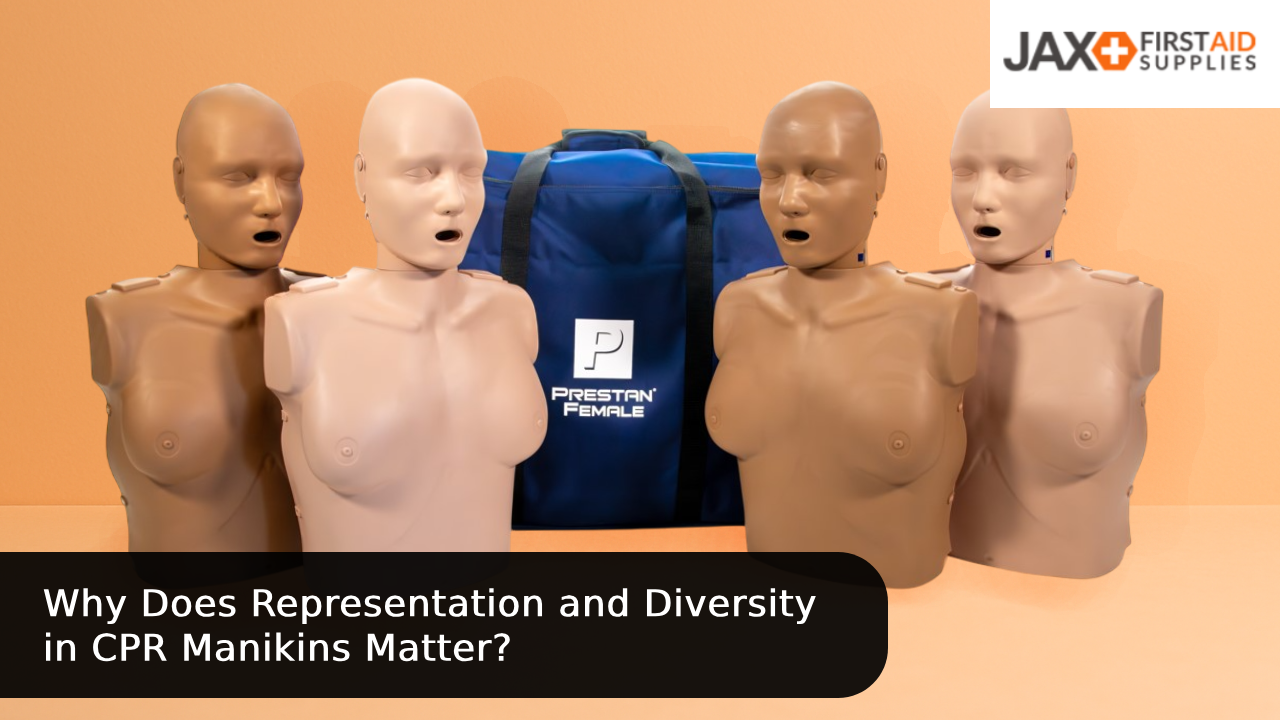
Inclusive first aid training is a lot more than just equal access to training, but should include equal representation of all. If trainees never see CPR demonstrated on a female CPR manikin or dark skinned manikins, an unconscious bias can carry over into real life emergencies.
The real world impact of representation in CPR and emergency training
A study by The Guardian has shown that nearly a quarter (23%) of people surveyed agree that they are less likely to give CPR to a woman in public than a man - often due to uncertainty, fear, or lack of exposure in training. As well as a study by the American College of Cardiology carrying out a study that revealed black and hispanic people who experience a witnessed cardiac arrest at home or in public are substantially less likely than white individuals to receive cardiopulmonary resuscitation (CPR) from a bystander. Realistic manikins help towards combatting these biases, making sure every trainee gains experience that reflects real world diversity.
The Problem with Traditional CPR Manikins
How Training Tools Have Historically Lacked Diversity
For many years, CPR training relied almost exclusively on light skinned, male CPR manikins. While effective for technique, they do not reflect the diversity of real world patients. The result of this leaves training that unintentionally leaves out key perspectives and individuals.
The consequences of “one-size-fits-all” CPR manikins
When trainees only get to practice their CPR technique on one type of CPR dummy, their confidence and response time could differ when faced with someone of a different body type, gender, or skin tone in a real emergency. This is why inclusivity is not a trend - it’s a training improvement.
Why are female CPR manikins important?
Female CPR manikins improve real world preparedness:
According to global studies, nearly a quarter of people agreed that they are less likely to give CPR to a woman in public than a man due to uncertainty, fear, or even lack of exposure to female CPR manikins in training.
Female CPR manikins give realistic chest structure and anatomy, which can assist trainees to better understand compression placement, and to overcome any hesitation in a real emergency on a woman. Representation helps build confidence - and confidence can save lives.
Jax First Aid proudly supplies female CPR manikins, made for realistic, inclusive training environments.
Why is there a need for dark skin CPR manikins in modern training?
Representation Matters for All Skin Tones
In diverse communities, first aid responders should feel comfortable and confident treating everyone - no matter their skin tone. Diverse CPR manikins help to improve that comfort by giving representation that mirrors real world patients.
CPR techniques stay the same regardless of skin tone, however, perception and familiarity can influence human behaviour. Practising on dark skinned manikins can help to build empathy, awareness, and readiness to act without hesitation.
Explore our dark skin CPR manikins to help trainees experience inclusive, high quality first aid education in the UK.
Inclusive first aid training: What does it look like in practice?
Using diverse training aids and equipment
Trainers should discuss inclusivity openly in sessions; not just in theory, but as part of practical learning. By highlighting unconscious bias in sessions, trainees can learn to give CPR confidently and compassionately to all.
A truly inclusive course uses a variety of training manikins, skin tones, ages and body types. Supplementary materials such as first aid training packs, bandages, and face shields should also be easily accessible and representative.
Example: Inclusive First Aid Training Pack Essentials
An ideal inclusive training kit may include:
- Female CPR manikins
- Diverse CPR manikins
- Male CPR manikins
- Child CPR manikins
- Infant CPR manikins
- Assorted face shields.
- Disposable gloves for all hand sizes
- Training bandages
- The addition of personalised clothing for your CPR manikins to simulate a more realistic emergency situation.
All these supplies can be found in our training equipment range.
FAQs About Inclusive First Aid and CPR Training
Q1. Why do we need female CPR manikins?
A: Female CPR manikins help to address gender bias in CPR training and improve anatomical accuracy.
Q2. Are dark skin manikins medically different?
A: They function the exact same, but can increase representation and familiarity for diverse communities.
Q3. How can first aid trainers promote inclusivity?
A: By using diverse manikins, discuss bias openly, and ensure materials reflect all demographics - such as age, gender and race.
Q4. What are the benefits of inclusive training kits?
A: Inclusive training kits, such as the Prestan Gold Bundle, which includes the option for dark skin manikins in adult, child and infant sizes - as well as a range of important first aid training supplies, to help improve realism, empathy, and real world readiness in medical emergencies.