
Why Should Every Workplace Have a Defibrillator?
Published by Jax First Aid Supplies on 17th Dec 2025
Why is it important that every workplace has a defibrillator?
When sudden cardiac arrest strikes, it gives no warning. A sudden cardiac arrest can happen in an office, on a factory floor, or even in a shop. Without immediate treatment, the odds of survival drop by the second. Having a defibrillator (AED) in your workplace is not just good safety practice, but a critical life saving investment that can make the difference between life and death for an individual suffering from cardiac arrest.
What is sudden cardiac arrest (SCA)?
What happens during a cardiac arrest?
Sudden cardiac arrest (SCA) is when the heart’s electrical system malfunctions, causing it to beat irregularly or even stop completely. Blood flow to the brain and organs stops within seconds, and the person becomes completely unresponsive and stops breathing normally.
It is very important to remember: cardiac arrest is not the same as a heart attack. A heart attack is caused by blocked arteries, while cardiac arrest is an electrical failure; however, one can trigger the other.
How quickly can cardiac arrest happen at work?
According to the Resuscitation Council UK, more than 30,000 people in the UK suffer out of hospital cardiac arrests every single year, many being in public or workplace environments. Without CPR and defibrillation, survival rates drop to less than 10%. But when an AED is used within 3 minutes, the chances of survival can increase to 70% or more.
Those statistics make one thing very clear: fast actions save lives.
What is a defibrillator (AED)?
How does a defibrillator work?
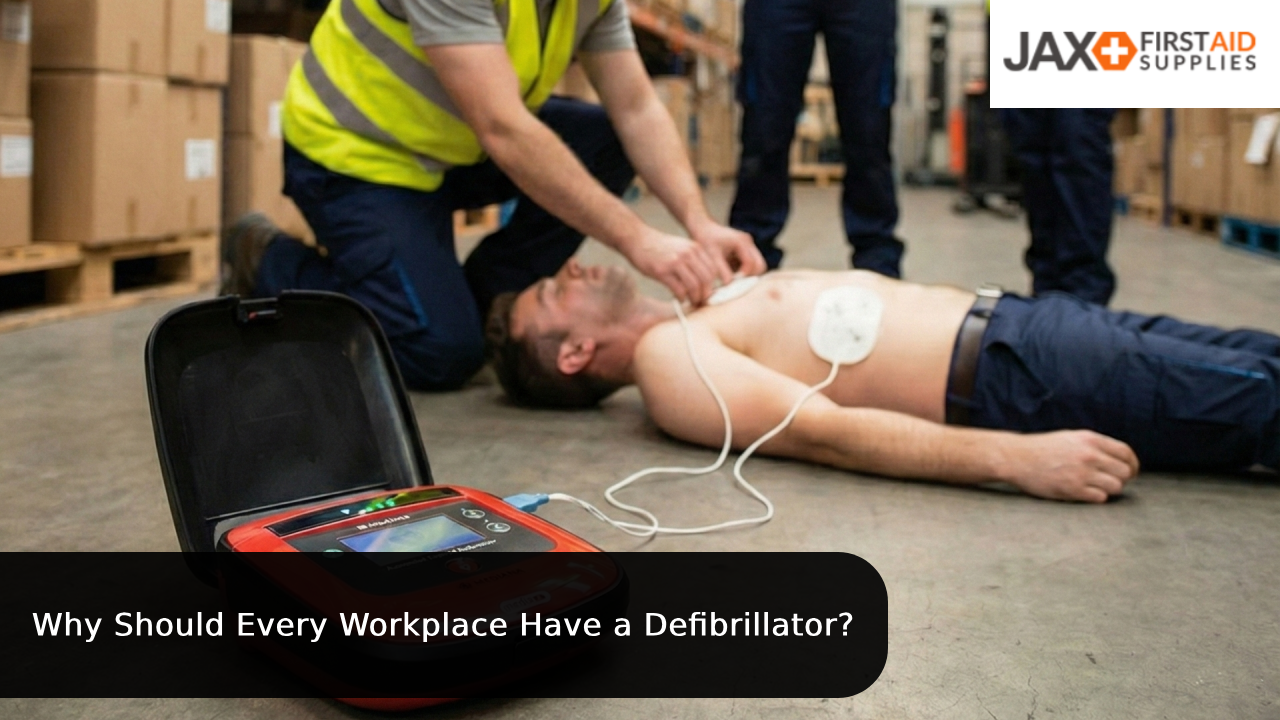
An Automated External Defibrillator (AED) gives a controlled electric shock to the individuals heart. This electric shock resets the heart’s rhythm, giving it a chance to beat normally again. AEDs such as the Mediana A15 HeartOn AED are made for public and workplace use, meaning no medical background is required to use one safely, due to its simple voice prompts and visual diagrams.
Why are AEDs safe and easy for anyone to use?
Modern automated external defibrillators are fully automated, and have simple to understand voice and visual prompts that help to guide the rescuer through each step. They even analyse the person's heart rhythm automatically, and only deliver a shock if and when needed.
This means that you can not accidentally harm someone with an AED defibrillator, as they are made to stop user error.
Why should every workplace have a defibrillator?
The UK Legal & First Aid Context:
Currently, there actually is no specific UK law that requires defibrillators to be kept in all workplaces. However, the Health and Safety (First Aid) Regulations 1981 do require employers to keep and provide adequate and appropriate first aid equipment, first aid supplies and facilities based on a risk assessment for that specific workplace.
For many workplaces, especially workplaces with large teams, customers, public on site, or remote locations (where ambulance response times might be longer than the crucial 5 minutes), an AED is both appropriate and essential. Failing to include an AED may be seen as failing the duty of care under the Health and Safety at Work Act 1974. This could potentially lead to legal liability for negligence, though there are no successful claims precedents in the UK for individuals who have tried to help in an emergency.
The Golden Minutes: Why Time Matters
In cardiac arrest, every single minute gone without defibrillation cuts survival rates by 10%. Ambulance response times can vary, especially in rural or busy urban areas, so having an AED on-site bridges that gap.
AED Accessibility: Public vs. Workplace Devices
While many UK towns now have community AEDs, they are not always close enough to the site of the sudden cardiac arrest. Even a 3 minute delay to grab a public AED can be too long. This is why having your own workplace defibrillator in a visible, accessible, and clearly marked location means that help is always just mere seconds away.
How should I choose the right workplace defibrillator?
Compact, User-Friendly Models: Mediana A15 HeartOn AED

Mediana A15 HeartOn AED
Description:
The Mediana A15 HeartOn AED is a top choice for UK workplaces. It is simple to use, features clear voice prompts, and automatically switches between adult and child modes, making it suitable for offices, schools, shops, and warehouses.
Highlights:
- Fully automatic defibrillator with clear voice prompts;
- Switches easily between adult and child modes;
- Compact, lightweight design for workplace or public use;
- Self-testing for reliable, always-ready performance;
- Increases survival rates with rapid, easy operation.
AED Prep Kit: Be Ready for Every Emergency

Defibrillator AED Prep Kit
Description:
The AED Prep Kit contains the essential accessories needed to prepare a casualty for use with an AED in an emergency, including cleansing wipe, disposable razor, gloves, hand towels, shears, waste bag and a resuscitation device.
Highlights:
- Everything needed to prepare a casualty for AED use;
- Includes scissors, razor, gloves, wipes, and face shield;
- Designed for rapid response during cardiac emergencies;
- Compact, sealed pouch - ideal for workplace defibrillator stations;
- Ensures fast, safe, hygienic AED application every time.
Storage & Protection: Heated Outdoor Metal Defibrillator AED Wall Cabinet

Outdoor Heated Metal AED Wall Cabinet
Description:
This outdoor wall mounting cabinet gives you security, practicality, high visibility and weather resistance in the event of an emergency. The cabinet is made from thick carbon steel with the addition of a shatterproof transparent window, allowing you to check the status of your defibrillator fast. Additionally, it has a waterproof seal and user regulated temperature settings. The AED cabinet also includes AED instruction icons to guide users on the correct procedure.
Highlights:
- Heated cabinet keeps AEDs operational in all weather;
- Prevents freezing - ideal for outdoor installations;
- Durable metal construction with secure lockable door;
- Keeps AEDs at recommended manufacturer temperatures;
- Highly visible, weatherproof design for quick emergency access.
Where should I position a defibrillator in my workplace?
The Resuscitation Council UK strongly recommends storing AEDs in high traffic, highly visible locations, such as:
- Near main entrances or a reception;
- On each floor of multi-storey buildings;
- Close to where physical work or exertion happens (such as warehouses, gyms);
- Within a 90 second (or ideally less) walk from anywhere in the building.
It is very important to make sure everyone knows the location of the AED, and to label it with both wall and directional signage.
Clear Signage: AED Signs & Directional Guidance
Visibility is very important, especially for visitors and guests who are not entirely familiar with the building. You should use clear signage to show where your AED is located, for example:
- A wall-mounted AED Sign that marks its position.
- A directional Nearest Defibrillator Sign that helps staff and visitors find it fast.
The faster an AED is found, more often than not leads to a much better outcome.
Maintenance and legal responsibilities:
AEDs are fairly low maintenance, but do need to be checked regularly. It is recommended to:
- Inspect the AED weekly for their readiness lights;
- Replace AED batteries/pads as per recommended by the manufacturer;
- Keep a logbook of all checks and expiry dates;
- Make sure signage and AED cabinets are visible and accessible.
It is also recommended to make sure that staff receive annual basic life support training, so that they are confident in using the AED when needed.
Every second counts - Protect your workplace now:
When an individual has a sudden cardiac arrest, speed can save their life. Installing a defibrillator is not just about compliance, but about giving your colleagues, customers, or visitors a much better chance of survival.
By equipping your site with a Mediana A15 HeartOn AED, keeping an AED Prep Kit close by, securing it in an AED Cabinet, and marking it with clear AED Signage, you aren’t just ticking off a box, but making your workplace safer for everyone who walks through the door.
Be prepared. Be protected. Be ready to save a life.