
Public Access Defibrillators: How to Make Sure People Can Find and Use Your AED
Published by Jax First Aid Supplies on 24th Jun 2026
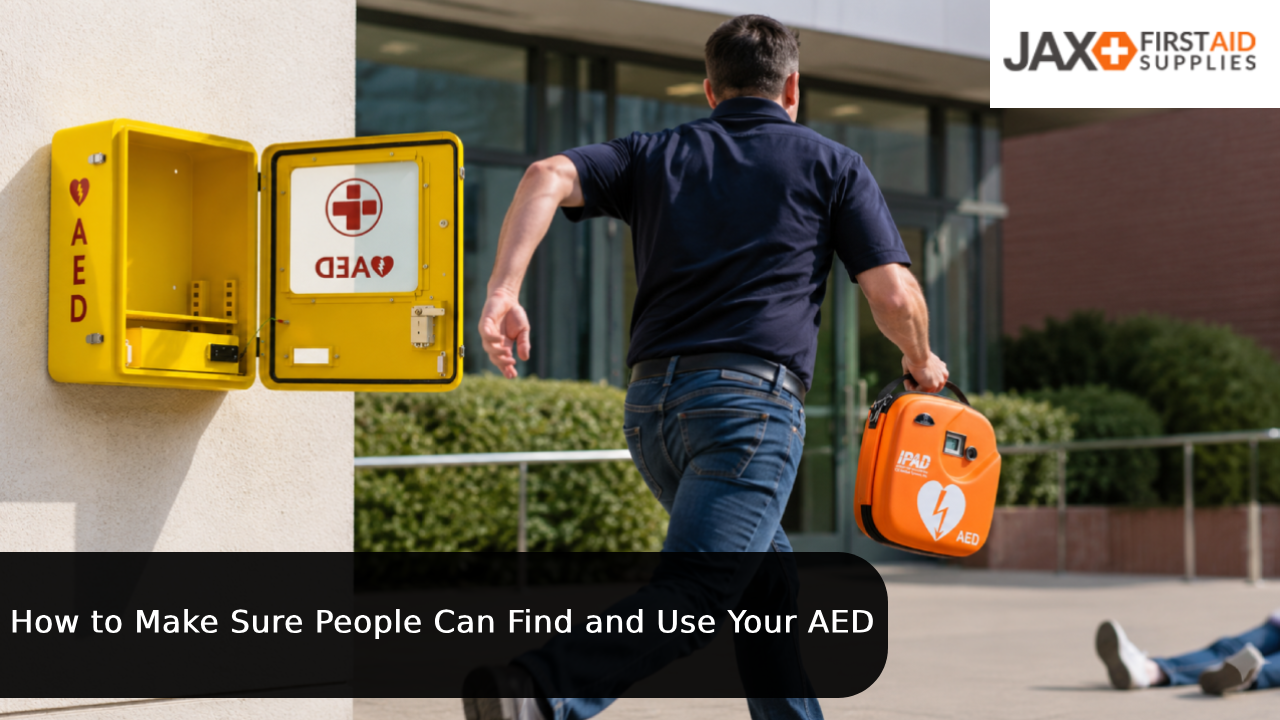
A public access defibrillator can help save lives when someone suffers a cardiac arrest in a workplace, school, gym, sports club, community building, retail site or public venue. The aim is simple: give members of the public, first aiders and bystanders immediate access to an AED before an ambulance arrives.
An AED, also known as an automated external defibrillator, is designed to analyse a person’s heart rhythm and, if it’s needed, deliver a shock. When used with CPR, early defibrillation can significantly increase the chance of survival during sudden cardiac arrest.
This guide explains how to use a defibrillator, how a public access defibrillator works with the ambulance service, why registration matters, where to keep an AED, and what workplaces, venues and community groups should consider when making a defib available in public spaces. If you’re ready to compare devices, you can browse our full range of workplace and public access defibrillators at any point.
Quick Answer: What Should You Do If Someone Needs a Defibrillator?
If someone is unresponsive and not breathing normally, call 999, start CPR and ask someone to find the nearest defibrillator. If a public access defibrillator nearby is available, switch it on and follow the voice instructions. The AED will tell you what to do, where to place each AED pad, when to stop CPR, and whether a shock is needed.
AEDs are designed to be used by people with or without medical training. The defibrillator will analyse the casualty’s heart rhythm and will only advise or deliver a shock if it detects a rhythm that may respond to defibrillation. Keeping a device alongside spare pads and accessories and inside a clearly marked AED cabinet means it’s ready the moment it’s needed.
What Is a Public Access Defibrillator?
A public access defibrillator is an AED that is available for emergency public use. It may be located in public areas such as shopping centres, sports clubs, gyms, schools, workplaces, village halls, factories, warehouses, offices, leisure centres, train stations, community buildings or outside on a wall in a heated cabinet.
The purpose of a public access AED is to give a bystander quick access to life-saving equipment during a cardiac arrest. Rather than waiting for paramedics to arrive before defibrillation starts, the emergency call handler may be able to direct someone to the nearest defibrillator if it is registered and available.
A public access defibrillator can be used by first aiders, staff, visitors, security teams, sports coaches, community responders or members of the public. These devices can provide clear voice and visual prompts that guide the user through the emergency one step at a time.
Why Public Access AEDs Matter During Cardiac Arrest
Cardiac arrest is a medical emergency where the heart stops pumping blood effectively. The casualty may collapse, become unresponsive and stop breathing normally. In this situation, the first few minutes are critical.
CPR helps move oxygenated blood around the body. A defibrillator can analyse the heart’s rhythm and, if needed, deliver an electric shock to the heart. This controlled electric shock may help restore a normal heart rhythm in certain types of cardiac arrest.
Public access AEDs matter because they put defibrillation closer to the casualty. If the nearest defibrillator is easy to find, clearly signed with the right AED location signage, accessible and registered on a defibrillator network, it may be used before the ambulance arrives.
How Does an AED Work?
An AED is designed to be simple in an emergency. Once switched on, it will provide voice prompts, visual prompts or both. The AED will tell the rescuer when to place pads on the casualty’s bare chest, when to stand clear, when it is analysing the heart rhythm, and when to continue CPR.
In simple terms, the AED works like this:
- The rescuer opens or switches on the AED.
- The device gives voice instructions.
- The rescuer places one pad on one side of the chest and the other pad in the position shown on the diagrams.
- The AED will analyse the heart’s electrical rhythm.
- If a shock is needed, a semi-automatic AED may tell you to press a button.
- A fully automatic AED may deliver a shock automatically after warning everyone to stand clear.
- After the shock has been given, the AED will tell you to continue CPR.
The important point is that the defibrillator tells the rescuer what to do. You do not need to diagnose the heart rhythm yourself. For organisations choosing their first device, a straightforward voice-guided model such as the semi-automatic AEDs in our range suits both trained and untrained rescuers.
How to Use a Public Access Defibrillator
To use a public access defibrillator, stay calm and follow the emergency steps. The AED is designed to help during an emergency, even if the user has no medical background.
Simple AED Emergency Steps
- Check the casualty: If they are unresponsive and not breathing normally, treat it as a cardiac arrest.
- Call 999: Start an emergency call and put the phone on speaker if possible.
- Start CPR: Begin chest compressions while someone else gets the AED.
- Switch on the AED: Follow the voice prompts and visual instructions.
- Attach the pads: Place the pads on the casualty’s bare chest as shown on the diagrams.
- Stand clear: Let the AED analyse the heart rhythm.
- Deliver a shock if told: Press the shock button if using a semi-automatic model, or stand clear if the AED is fully automatic.
- Continue CPR: Continue CPR for two minutes or until the AED tells you to pause again.
- Keep going: Continue until the casualty shows signs of life, the ambulance service arrives, or you are physically unable to continue.
Do not delay using the AED because you are worried about making a mistake. The device will not deliver a shock unless the rhythm is suitable for defibrillation. Preparing the chest quickly matters too — a defibrillator prep kit containing scissors, a razor and wipes helps the pads stick to clean, dry skin.
Call 999 First or Find the Nearest Defibrillator First?
If someone is in cardiac arrest, call 999 immediately. The emergency call handler can guide you through CPR and may help locate the nearest defibrillator. If other people are nearby, one person should call 999 while another starts CPR and another goes to find the AED.
The ambulance service may be able to direct a bystander to a registered public access defibrillator nearby. This is why it is so important for workplaces, venues and community groups to register their AED and keep the access information updated.
What Is the Defibrillator Network?
The UK’s national defibrillator network is called The Circuit. It helps NHS ambulance services know where defibrillators are located, when they are available and how they can be accessed during an emergency.
If a public access defibrillator is registered, an ambulance call handler may be able to direct a bystander to it during a 999 call. If it is not registered, the ambulance service may not know that the defibrillator exists, even if it is installed nearby.
For a workplace, school, sports club or venue, installing the AED is only part of the job. The defib should also be registered, checked, maintained and clearly signed so people know that the defibrillator is available. Keeping a defibrillator inspection tag on the cabinet makes it easy to log those routine checks.
How to Find Your Nearest Defibrillator
In an emergency, the safest route is to call 999 and follow the emergency call handler’s instructions. They may be able to help find your nearest defibrillator if one is registered and accessible.
Outside an emergency, workplaces and community groups should make staff aware of the defibrillator location. You can also improve access by fitting a wall-mounted projecting AED sign that’s visible from a distance, using a visible cabinet and keeping internal first aid communication up to date. If the AED is for public use, consider whether people can find it from car parks, entrances, sports areas, reception desks and high-footfall routes.
Good places to make AED locations visible include:
- Reception areas
- Security desks
- Sports hall entrances
- Gym receptions
- School offices
- Warehouse or factory entrances
- Community building entrances
- Public noticeboards
- Staff first aid boards
Product Pick: AED Nearest Defibrillator Sign

AED Nearest Defibrillator Sign 300 x 200mm
Clear AED signage helps staff, visitors and members of the public identify where a defibrillator can be found during an emergency.
Best use cases: workplaces, schools, sports clubs, public venues, gyms, warehouses, factories, community buildings and reception areas.
Public Access AEDs and Ambulance Response
A public access defibrillator supports ambulance response by allowing CPR and defibrillation to start before professional emergency medical help arrives. The ambulance crew brings advanced care, but the first few minutes often depend on the people already on scene.
During the emergency call, the call handler may ask questions such as:
- Is the casualty awake?
- Is the casualty breathing normally?
- Where exactly are you?
- Is there a defibrillator nearby?
- Can someone bring the defibrillator to the casualty?
- Is someone doing CPR?
If the AED is registered and accessible, the call handler may be able to provide location or access details. This can help a bystander retrieve the AED rather than waiting for paramedics to arrive.
Anyone Can Use an AED
Many people worry that they need training before they can use an AED. Training is useful, but AEDs are designed to be used by the public. They provide clear voice prompts and visual instructions so the rescuer can follow each step.
If you are a workplace, venue or community group, AED awareness training can still help. It improves confidence, helps staff practise CPR, and makes people more likely to act quickly during an emergency. Many organisations build that confidence using a dedicated AED trainer — the Prestan AED Ultra Trainer lets learners rehearse the full sequence without a live device, while the UltraTrainer 4 Pack suits course providers running larger sessions. Replacement universal trainer pads keep those units going between courses.
Product Pick: Prestan AED Ultra Trainer
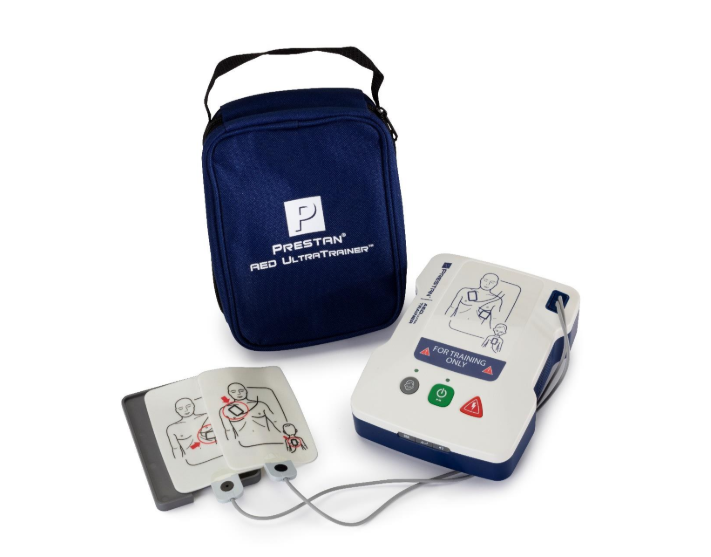
Prestan AED Ultra Trainer
A training AED for teaching staff, learners and first aiders how to respond during a cardiac arrest without using a live medical device.
Best use cases: first aid training, CPR courses, workplace AED awareness, schools, gyms, sports clubs, staff refreshers and venue safety training.
Public Access Defibrillator Locations: Where Should an AED Be Kept?
A public access defibrillator should be easy to find, clearly marked and available when people are most likely to need it. The best location depends on the site layout, opening hours, footfall and risk profile.
Good AED locations include:
- Outside a building in a suitable AED cabinet
- Near a main entrance
- Near reception or a security desk
- Near sports pitches, gyms or changing rooms
- Near a first aid room or first aid point
- Near high-footfall public areas
- Near warehouses, factories or industrial site offices
- Near community building entrances
The AED should not be hidden in a private office, cupboard or locked room unless there is a clear and fast access process. If the device is in a locked cabinet, the access method must be reliable during a 999 call.
AED Cabinets for Public Access
AED cabinets help protect the defibrillator and make the location obvious. Indoor cabinets can support visibility and security, while a weatherproof outdoor AED cabinet can help protect against weather, dust and water.
For public locations, a cabinet may need to be:
- Highly visible
- Easy to access
- Weather-resistant
- Heated where needed
- Clearly marked
- Suitable for the AED model
- Included in routine checks
You can compare indoor and outdoor options across our full range of AED cabinets and storage to find one that fits your device and location.
Product Pick: Polycarbonate Outdoor AED Cabinet

Polycarbonate Outdoor AED Cabinet
An outdoor AED cabinet helps make a public access defibrillator more visible while protecting the device from outdoor conditions.
Best use cases: schools, sports clubs, factories, community buildings, village halls, public venues, business parks and public access AED points.
What Should Be Kept With a Public Access Defibrillator?
A defibrillator should be ready to use. That means the AED itself should be present, pads and batteries should be in date, and supporting accessories should be available where appropriate. It’s worth keeping a spare set of replacement pads and batteries close by, since pads need changing after every use and have a shelf life even when unused.
Alongside the device, a defibrillator prep kit helps a rescuer expose and dry the casualty’s chest quickly, while a defibrillator inspection tag gives workplaces and venues a simple way to record routine checks. Clear AED signage completes the setup so people can find the device under pressure.
Product Pick: Defibrillator AED Prep Kit

Defibrillator AED Prep Kit
A practical accessory kit to support AED use by helping prepare the casualty’s chest quickly and safely during an emergency.
Best use cases: workplaces, public venues, gyms, sports clubs, schools, first aid rooms, AED cabinets and public access defibrillator points.
How Public Access AEDs Improve Survival Rates
Public access AEDs can improve survival rates by reducing the delay before defibrillation. If a bystander starts CPR and someone retrieves the AED quickly, the casualty has a better chance than if everyone waits for the ambulance before taking action.
The best chance of saving a life comes from a fast chain of response:
- Recognise cardiac arrest quickly
- Call 999
- Start CPR
- Find the nearest defibrillator
- Use the AED and follow the prompts
- Continue CPR until help arrives
This is why public access defibrillator placement, AED registration, signage and staff awareness all matter. The device needs to be close enough, visible enough and ready enough to be used within the first few minutes.
Do You Need Training to Use an AED?
You do not need formal medical training to use an AED in an emergency. AEDs are designed for public use and provide clear instructions. However, first aid training and AED awareness can improve confidence and reduce hesitation.
Workplaces and venues may choose to train staff so they can:
- Recognise sudden cardiac arrest
- Call 999 quickly
- Start CPR
- Use an AED confidently
- Send someone to retrieve the defibrillator
- Continue CPR until the ambulance arrives
- Check and maintain AED equipment
For trainers and organisations, our range of AED trainers allows realistic practice without using a live defibrillator, and pairing them with CPR manikins lets learners rehearse compressions and defibrillation together as one continuous drill.
Public Access AED Maintenance Checklist
A public access defibrillator must be emergency-ready. The device should be checked regularly so people can trust it during an emergency.
AED Check List for Workplaces and Venues
- Is the AED in its correct location?
- Is the cabinet visible and easy to access?
- Is the device status indicator showing ready?
- Are the pads sealed and in date?
- Is the battery in date?
- Is the AED registered on the defibrillator network?
- Are opening hours or access details up to date?
- Is the signage still visible?
- Is the AED prep kit complete?
- Has the inspection tag been updated?
- Do staff know where the AED is?
- Has the AED been checked after use?
Common Public Access Defibrillator Mistakes
Installing an AED is a strong step, but it needs to be visible, accessible and maintained. A defibrillator hidden away, not registered or missing replacement pads may not help during an emergency.
Common mistakes include:
- Not registering the defibrillator
- Storing the AED somewhere people cannot find it
- Not using clear signage
- Not checking pads and batteries
- Not telling staff where the AED is kept
- Using a locked cabinet without a reliable access process
- Not updating access hours on the defibrillator network
- Not replacing pads after use
- Assuming people will know what to do without awareness training
Recommended AED Products From Jax First Aid
Jax First Aid supplies defibrillators, AED cabinets, signage, pads and accessories and AED trainers for UK workplaces, schools, venues, community groups and public access locations.
Defibrillators
Shop AEDs for workplaces, public venues, schools, sports clubs, gyms and community spaces.
AED Cabinets
Protect and display your public access defibrillator with indoor or outdoor storage.
Pads and Accessories
Keep your AED ready with prep kits, inspection tags, replacement pads and accessories.
AED Trainers
Support staff confidence and first aid training with realistic AED trainer devices.
Final Thoughts: Public Access Defibrillators Save Time When Every Second Counts
A public access defibrillator is most useful when it can be found quickly, accessed quickly and used confidently. During sudden cardiac arrest, the chain of response starts with recognition, 999, CPR and fast defibrillation.
For workplaces, venues, schools, sports clubs, gyms, community groups and public spaces, the goal is not just to buy a defibrillator. The goal is to make sure people know where it is, can access it, can follow the prompts and can keep CPR going until the ambulance arrives.
Whether you’re fitting your first device or topping up an existing setup, you can find everything in one place — from AEDs and defibrillators and weatherproof AED cabinets to pads and accessories, AED trainers and AED signage for organisations across the UK.
Need AED Supplies for a Workplace or Public Location?
Shop defibrillators, AED cabinets, signs, prep kits, inspection tags, replacement accessories and AED trainers from Jax First Aid.
Shop Defibrillators Shop AED Cabinets Shop AED Accessories Ask About Bulk Orders
Frequently Asked Questions
What is a public access defibrillator?
A public access defibrillator is an AED that is available for emergency use by members of the public, staff, first aiders or bystanders. It is usually placed in a visible and accessible location such as a workplace, school, sports club, public venue or community building.
Can anyone use a defibrillator?
Yes. AEDs are designed to be used by the public. The device gives voice prompts and visual instructions, analyses the casualty’s heart rhythm and will only advise or deliver a shock if it is needed.
Should I call 999 before using an AED?
Yes. If someone is unresponsive and not breathing normally, call 999 immediately, start CPR and ask someone to get the nearest defibrillator. The emergency call handler can guide you through the response.
What is the defibrillator network?
The UK national defibrillator network is called The Circuit. It provides ambulance services with information about registered defibrillators so call handlers may be able to direct bystanders to a nearby AED during an emergency.
Where should a public access AED be kept?
A public access AED should be kept somewhere visible, accessible and clearly signed. Good locations include main entrances, reception areas, sports halls, gyms, school offices, community buildings and external AED cabinets.
Do AEDs need maintenance?
Yes. AEDs should be checked regularly to make sure the device is present, the status indicator shows ready, pads and batteries are in date, signage is visible and access details are up to date.
Can Jax First Aid supply public access defibrillator equipment?
Yes. Jax First Aid supplies defibrillators, AED cabinets, AED signs, prep kits, inspection tags, replacement accessories and AED trainers for workplaces, schools, venues, sports clubs and community groups across the UK.