
Back-to-School First Aid Checklist 2026: What Should Schools Check Before September?
Published by Jax First Aid Supplies on 29th Jul 2026
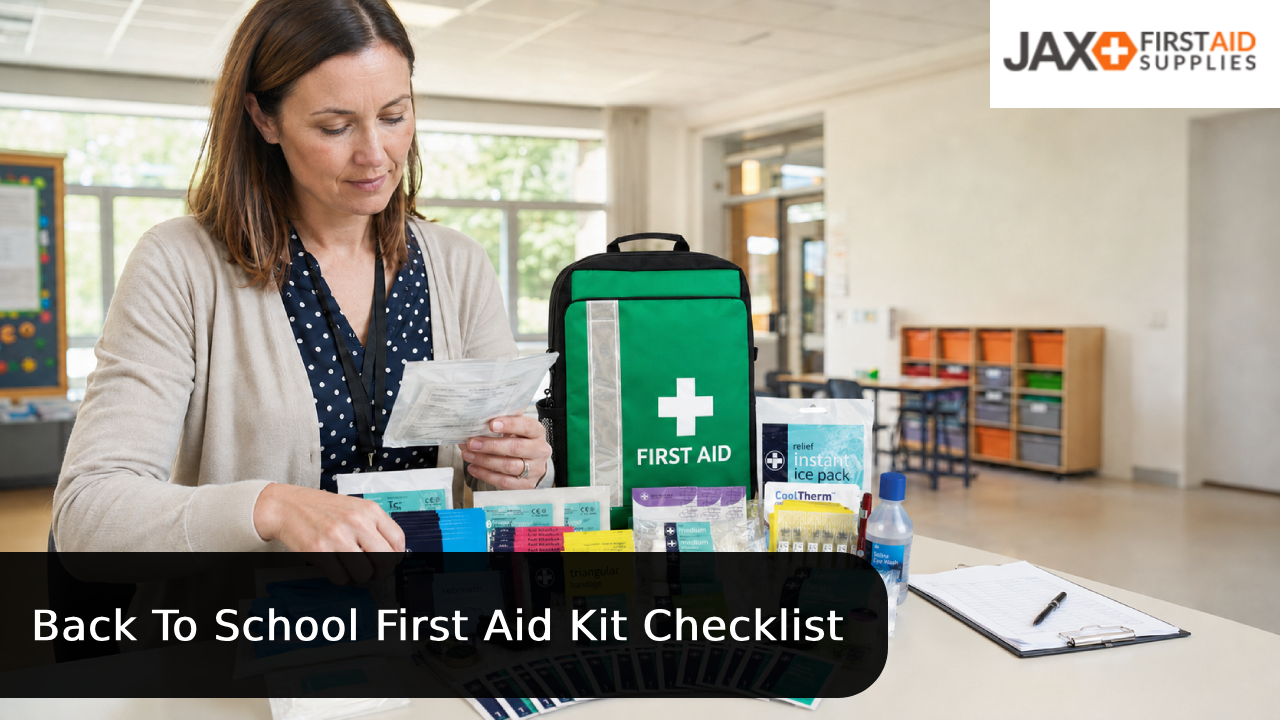
Back-to-School First Aid Checklist 2026
Before children return in September, schools have an important opportunity to review their first aid arrangements, replace used or out-of-date supplies and confirm that staff know exactly what to do when somebody is injured or becomes unwell.
A good back-to-school review should cover much more than opening the main first aid box and counting plasters. It should consider the whole school environment: classrooms, reception, playgrounds, sports areas, science and technology rooms, kitchens, minibuses, off-site activities, the treatment room, staff training, children’s medical needs, accident records and any automated external defibrillator (AED) kept on site.
This back-to-school audit is designed to help headteachers, business managers, site teams, trained staff and health and safety leads prepare for the 2026/27 academic year. It applies most directly to schools and colleges in England, although the practical checks will also be useful to education settings elsewhere in the UK alongside the guidance that applies in their nation.
Quick Answer: What Should Schools Check Before September 2026?
Every school should review its needs assessment, inspect every container, check expiry dates, replace used stock, confirm kit locations, verify staff certificates, review cover for absence, update children’s medical information, prepare travelling kits and test its incident-recording process. Schools with an AED should also check its status indicator, pads, battery and rescue accessories. Early years settings must prepare for the EYFS framework applying from 1 September 2026.
Why a Back-to-School Review Matters
The summer break can create gaps in first aid provision. Supplies may have been used during summer activities, dated items can become unsuitable, rooms may be reorganised and trained employees may leave or change roles. A kit that was suitable in July may therefore not be ready when students and staff return.
The Department for Education guidance on first aid in schools is the main first aid guidance for employers, governing bodies and senior leaders in England. It says equipment, facilities and personnel should be based on a first aid needs assessment and should allow care to be given without delay.
The Health and Safety (First-Aid) Regulations 1981 place duties on employers in relation to their employees. Although those regulations do not specifically require schools to provide care to non-employees, DfE and HSE strongly recommend that children, students and visitors are considered when provision is planned. In practice, the system should reflect everyone who may be present on the site.
Back-to-School First Aid Kit Checklist for 2026
Use the following aid kit checklist for schools as the starting point for a full pre-term inspection. It is not a substitute for your own assessment because the correct equipment and level of cover will vary between a small infant or junior setting, large secondary schools, a specialist setting and a multi-building college campus.
| Area to check | Back-to-school action | Completed |
|---|---|---|
| Needs and risk assessment | Review changes to roll numbers, staffing, premises, activities and known risks. | □ |
| Medical kits | Open every kit, compare contents with its list and replace missing, opened or damaged items. | □ |
| Dated products | Review use-by information and safely remove anything that is out of date. | □ |
| Kit locations | Confirm equipment is accessible, clearly marked and available in higher-risk or distant areas. | □ |
| Staff competence | Check certificates, planned retraining and cover during breaks, trips and absence. | □ |
| Medical information | Update individual healthcare plans and emergency contact procedures. | □ |
| Treatment room | Inspect cleanliness, access, couch, storage, signage and consumables. | □ |
| Trips and vehicles | Prepare portable kits and check minibus equipment before use. | □ |
| AED | Check the status indicator, pads, battery, cabinet and rescue accessories. | □ |
| Incident records | Confirm forms, privacy controls, parent notifications and reporting responsibilities. | □ |
1. Review Your First Aid Needs Assessment
The first task is to review the school’s existing assessment. This should consider the number and age of children, employees and visitors; the size and layout of the site; previous first aid incidents; specific hazards; staff working patterns; and how quickly professional medical assistance could arrive.
Look for changes since the previous academic year. Has capacity increased? Has a new building, workshop, kitchen, sports area or temporary classroom opened? Will more clubs run after school? Are contractors, lettings or community groups using the premises? Has the pattern of accidents shown repeated problems in one location?
Schools may need more equipment where buildings have several floors, departments are separated, playing fields are distant or higher-risk lessons take place. Every school must make its own evidence-based decision rather than relying on a generic kit quantity. The assessment should identify suitable equipment, facilities and people for normal hours, extended activities and emergencies. For a closer look at how a first aid needs assessment shapes the supplies you stock, our workplace checklist walks through the same process step by step.
2. Inspect Each Kit Across the School
At least one fully stocked first aid container should be available for each site, but many schools will need several. The exact number should follow the assessment and account for large or split-level premises, playgrounds, sports fields, practical teaching areas and educational visits.
Open every kit rather than relying on an intact seal or an inspection label. Compare the contents with the manufacturer’s list and record anything that is missing. Check that sterile wrappers are undamaged, gloves remain usable, liquids have not leaked and scissors or other reusable items are clean and working.
There is no single mandatory list of items that fits every school or college. HSE’s suggested minimum for a low-risk workplace includes guidance, assorted sterile plasters, sterile eye pads, triangular bandages, safety pins, medium and large wound dressings and disposable gloves. The school must then add or increase supplies where its assessment identifies additional needs.
Depending on the setting, useful additions may include instant ice packs for PE and playground injuries, eyewash for science or technology areas, burn dressings for kitchens, resuscitation face shields, foil blankets, vomit bags and body-fluid response supplies. Medication should not be stored inside the general box.
For a more detailed contents guide, read our full breakdown of what should be in a school first aid kit. If your science or design-technology rooms need dedicated eye protection provision, our emergency eye wash stations buying guide compares bottles, pods and wall-mounted stations.

Product Pick
Paediatric Kit for Schools
This compact kit contains individually packed dressings, eye pads, plasters, gloves, wipes, a resuscitation aid and other essentials in a strong wall-mountable box. It is a practical option for primary, nursery and childcare environments where a smaller ready-made kit is required.
Best for: reception areas, classrooms, primary schools, nurseries and early years provision.
View Paediatric School Kit3. Check Dated Products and Refill Used Stock
Kits should be checked frequently throughout the year and replenished as soon as possible after use. The back-to-school inspection should be more detailed: remove every dated product, review its use-by information and make a list of anything due for replacement during the next term.
Do not leave replacement ordering until the last day of the holidays. A product that reaches the end of its stated shelf life should be removed and discarded safely. Opened, contaminated, water-damaged or badly crushed packaging should also be replaced even when the printed date has not passed. In most cases a first aid kit refill restores the contents without the cost of replacing the whole box; where a container itself is damaged or no longer suitable, our guide to the best first aid kits for 2026 will help you choose a replacement.
Assign responsibility to a named person and use an inspection tag, paper log or digital record. Keep a small reserve of frequently used supplies so that busy areas are not left short after several incidents. The aim is to begin term with each full kit complete and ready to use.
Jax Back-to-School Tip
Do not inspect only the main office kit. Include portable playground bags, PE kits, science and food-technology supplies, minibuses, reception, after-school clubs and any emergency bags stored away from the central treatment room.
4. Confirm Kit Locations, Access and Signage
Equipment should be easy to identify and reach quickly. A suitable container is normally marked with a white cross on a green background and should be stored in a clean, dry location. Where practical, DfE guidance recommends placing it near handwashing facilities.
Walk the site as if you were responding to an emergency. Can staff unlock the room or cabinet without searching for a key? Are temporary classrooms and distant playing fields covered? Have building works moved a kit or blocked a sign? Can new employees and supply staff find help without already knowing the site?
Emergency notices and clear first aid signs should show where equipment and facilities are located and how to contact the designated first aider or appointed person. Place clear information where staff, visitors and contractors will see it, and include the arrangements in induction material.
5. Check Certificates, Training and Cover
The number and level of qualified responders should follow the assessment rather than a fixed national ratio. In most schools, it is likely to identify that at least one trained person is needed, but larger premises, higher-risk activities, extended hours and staff absence may make additional cover necessary.
Check the date on every valid first aid certificate and arrange requalification before it expires. Certificates are usually valid for three years. Standard First Aid at Work or Emergency First Aid at Work training may meet identified employee needs, but additional paediatric first aid training may be appropriate where the arrangements also cover younger pupils.
An appointed person does not need formal training, although an emergency first aid at work course can be beneficial. Their role is to take charge of the arrangements, care for equipment and summon professional help when required. This role is different from that of a qualified responder.
HSE strongly recommends annual refresher training so that practical skills remain current, but these annual refreshers are not themselves a legal requirement. Before term starts, test whether enough trained people will be present during lessons, lunch, breakfast clubs, after-school activities, trips and staff absence.
If the school uses an external provider, check that it is competent and that the course matches the risks identified. Workplace and paediatric courses cover different needs; the title of a course should not be chosen without checking its syllabus.
6. Prepare Early Years Provision for September 2026
The revised EYFS statutory framework takes effect on 1 September 2026, making this summer review particularly important for school-based early years settings. Providers should read the version that applies from September rather than relying on an older saved copy.
The framework requires at least one person with a current paediatric first aid certificate to be on the premises and available whenever children are present, and to accompany children on outings. Paediatric first aid must be renewed every three years and must be suitable for people caring for young children and, where relevant, babies.
Check rotas, reception-class cover, wraparound care, lunch arrangements and planned visits. A paediatric first aider must be able to respond quickly, so the number of children, staff and layout of the school premises all matter. Providers should also check how certificate requirements affect which employees may be included in staff-to-child ratios.
7. Update Medical Information and Emergency Procedures
Before the first day, review individual healthcare plans for pupils with medical conditions. Confirm emergency contacts, authorised medicines, storage locations, staff responsibilities and the procedure for calling emergency services. New starters and children whose needs have changed should be prioritised.
Keep medication management separate from the general kit inspection. Workplace emergency care does not normally include administering medication, and routine medicines should not be stored inside general medical kits. Schools should follow their medicines policy and the relevant statutory guidance for supporting children with health needs.
Make sure relevant school staff understand symptoms and agreed actions for conditions such as asthma, epilepsy, diabetes and severe allergies. Information should be shared appropriately while protecting confidentiality.
8. Inspect the School Treatment Room
The needs assessment may identify the need for a dedicated room or suitable medical accommodation. Before September, check that the space is clean, accessible, appropriately signed and available when required. It should not have become a general storage area during the summer.
Inspect the couch, pillow, blankets, paper roll, trolley, lighting, ventilation, handwashing arrangements and storage. Confirm that surfaces can be cleaned and that supplies are organised so staff do not have to search during an incident. Where children have complex needs, the accommodation should reflect those needs.
Any lockable storage should balance security with rapid access. Keep normal medication under the school’s medicines arrangements rather than mixing it with the main kit. Display current contact information and remove notices naming employees who have left.
Product Pick
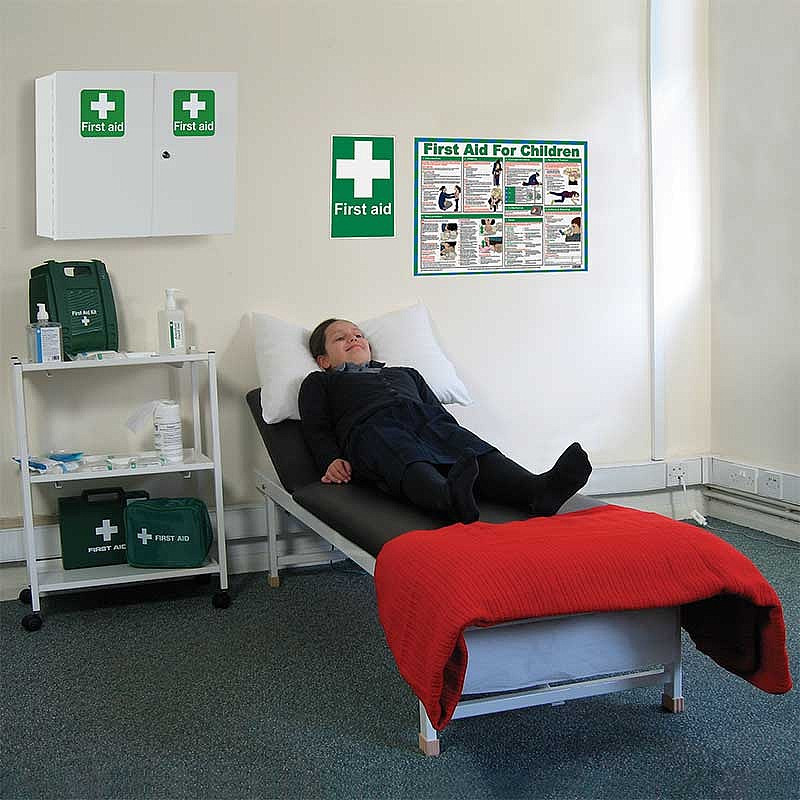
Complete School First Aid Room
This package combines a low-level medical couch, trolley, cabinet, blanket, pillow, couch roll, poster and signage to help education settings create an organised treatment space.
Best for: schools setting up a new medical room or replacing older furniture and facilities.
View Room Package9. Prepare Kits for Playgrounds, PE and Off-Site Activities
Provision must extend beyond the main building. Review what is needed for playground duty, sports fixtures, fieldwork, educational visits and other off-site activities. The visit leader should assess the destination, group size, journey, planned activity, individual needs, mobile coverage and access to emergency assistance.
A portable bag should be clearly marked, easy to carry and organised so the responder can reach supplies quickly. Check that it returns from each trip, is inspected after use and does not remain forgotten in a vehicle.
School minibuses and larger passenger vehicles may be subject to specific equipment rules. Confirm that a compliant PSV first aid kit is present, clearly marked, in good condition and readily accessible. Sports areas may need additional cold packs, wound dressings and other items identified by the activity assessment. If the school hosts fairs, fixtures or community events with larger crowds, our guide to first aid supplies for festivals, concerts and public events covers provision at that scale.

Product Pick
School Trip First Aid Kit
This 165-piece portable rucksack includes organised medical supplies, eyewash, vomit bags, a whistle and a detachable grab-and-go compartment for outings and outdoor activities.
Best for: educational visits, field trips, sports events, guides, scouts and cadet groups.
View School Trip Kit10. Check the School Defibrillator
If your school has an AED, make it part of the reopening inspection rather than assuming its self-test means no action is needed. DfE guidance says schools should have a procedure for checking warning indicators regularly and no less frequently than weekly, with a record showing that checks have taken place – an AED inspection tag attached to the unit is a simple way to evidence this.
Check the device status indicator, defibrillator cabinet, door closure, signage and accessibility. Review the manufacturer’s manual for any additional monthly or annual tasks. Check the use-by dates on adult and paediatric pads, confirm that the correct pads are stored with the device and inspect the battery indicator.
Rescue accessories may include protective gloves, scissors, a safety razor, dry wipes and a face shield. Keep spare consumables where appropriate so an AED is not left unavailable after use. Pads and batteries have finite service lives even when the machine has never been used.
Although schools follow DfE guidance rather than workplace standards, the two minute access expectation introduced by the updated BS 8599-1:2026 first aid standard is a useful benchmark when deciding where a device is positioned on a large or multi-building site.
Schools that do not yet have a device can read the AED and defibrillator buyer’s guide and browse defibrillators, cabinets, pads and accessories.
11. Review Accident Records and Reporting
DfE guidance strongly recommends recording all incidents that require a qualified member of staff or appointed person. Useful details include the date, time and location; the person involved; the injury or illness; treatment provided; what happened afterwards; and the name and signature of the person dealing with it.
This general incident record is not automatically the same as the statutory accident book, although a school can combine appropriate systems. Only specified incidents are reportable under RIDDOR, so staff responsible for reporting should understand the thresholds rather than treating every minor injury as reportable.
Before term begins, check that forms are available, personal information is stored securely and the process for informing parents or carers is clear. Reviewing patterns in incidents can also help the next formal review—for example, repeated playground falls may point to a surface, supervision or maintenance issue.

Product Pick
School Accident Book Duplicate
This compact book contains 40 duplicate incident forms. The removable top copy can be provided to a parent or carer while the second copy remains securely in the book.
Best for: injury and illness records where the school wants an immediate duplicate copy.
View School Accident Book12. Make Sure Everyone Understands the Arrangements
A well-equipped school can still lose valuable time if nobody knows where the equipment is or whom to contact. Use inset days and staff induction to explain locations, internal contact procedures, emergency numbers, reporting forms and the roles of qualified staff and appointed persons.
Information should reach permanent employees, new starters, agency workers, lunchtime supervisors, sports coaches, volunteers, contractors and others who may need it. Suitable notices should also help children and visitors identify where assistance is available.
Since September 2020, state-funded schools in England have been required to teach Health Education. Current curriculum guidance includes basic first aid and emergency calls for primary pupils, while secondary pupils should learn further life-saving skills, including CPR and the purpose and use of defibrillators. Schools may use a first aid training pack with CPR manikins and AED trainers to make this teaching practical and memorable.
A Simple Seven-Day Back-to-School Action Plan
Start early enough to order replacements and arrange training before children arrive. A practical sequence is:
- Day one: review the assessment, incident history and any changes to the site or school population.
- Day two: locate and open every kit, cabinet and portable bag.
- Day three: inspect dated items and place one combined replenishment order.
- Day four: verify certificates, staff rotas and emergency cover.
- Day five: inspect the medical room, AED, signage and accident-recording system.
- Day six: update healthcare information and prepare trip, sports and minibus kits.
- Day seven: brief employees, complete the audit and record who will carry out future inspections.
Equip Your School for September
Jax First Aid supplies education settings across the UK with first aid kits, refills, school accident books, ice packs, gloves, wound-care products, eyewash, sick bags, medical furniture, AEDs, signage and portable trip bags.
Whether you need to replenish one classroom box or equip your school across several buildings, the schools and education range brings together practical products for primary, secondary, nursery, college and university settings. Purchase orders and bulk quotations are available for schools, academies and multi-academy trusts.
Get Your School Ready Before September
Shop kits, refills, incident books, trip bags, treatment-room equipment and other essentials for the new academic year.
Shop School Supplies Shop First Aid Kits Shop Accident Books
Frequently Asked Questions
What should schools check before children return in September?
Schools should review their needs assessment, inspect and replenish every kit, remove out-of-date products, verify training certificates, check the medical room and AED, update healthcare information, prepare off-site equipment and confirm incident-recording procedures.
Is there a fixed legal contents list?
There is no universal mandatory contents list for every education setting. Equipment should be selected using the school or college’s assessment, with HSE’s suggested workplace contents acting as a minimum guide where no special risks are identified.
How often should school kits be checked?
DfE guidance says kits should be checked frequently and replenished as soon as possible after use. A named person should carry out and record inspections, with a full review before each new term being sensible practice.
Do medical supplies expire?
Many sterile products, liquids, dressings and AED consumables carry use-by dates. Out-of-date products should be removed and disposed of safely, while damaged, contaminated or opened items should be replaced regardless of date.
Do schools need a qualified responder?
The required personnel should be determined by the needs assessment. DfE guidance says that, in the vast majority of cases, it would expect the assessment to identify a need for at least one qualified person. Where one is not required, the employer must still appoint someone to take charge of arrangements.
How long does a school certificate last?
Certificates are usually valid for three years, but schools should check the specific qualification and arrange retraining before it expires. HSE also strongly recommends annual skills refreshers.
What are the paediatric requirements for early years settings?
At least one person with a current full paediatric qualification must be on the premises and available whenever children are present and must accompany children on outings. Training must be renewed every three years. Providers should consult the EYFS framework applying from 1 September 2026.
Do schools need a separate kit for trips?
The visit leader should assess the destination, group, activities and individual needs before each visit. A portable kit is normally required, and additional items may be necessary for remote locations or specialised activities.
How often should a school AED be checked?
DfE guidance says warning indicators should be checked regularly and no less frequently than weekly. Schools should also follow the device manual, inspect the cabinet and record checks of pads, batteries and other consumables.
Where can schools buy kits and replacement supplies?
The Jax range includes ready-made school kits, refills, dressings, cold packs, eyewash, accident books, trip bags, AED equipment and medical-room furniture for education settings across the UK.